

What 80's Rock Band Had Cat Tattoos
| Black Flag | |
|---|---|
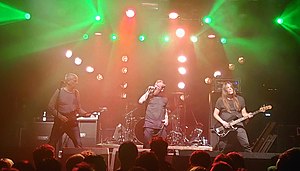 Black Flag performing at the Electric Ballroom in Camden 2019 | |
| Background data | |
| Also known as | Panic (1976 - 1978) |
| Origin | Hermosa Beach, California, U.S. |
| Genres |
|
| Years active |
|
| Labels | SST |
| Associated acts |
|
| Members |
|
| Past members |
|
Blackness Flag is an American punk rock ring formed in 1976 in Hermosa Embankment, California. Initially called Panic, the band was established by Greg Ginn, the guitarist, master songwriter, and sole continuous fellow member through multiple personnel changes in the ring. They are widely considered to be one of the first hardcore punk bands, as well every bit ane of the pioneers of post-hardcore. Subsequently breaking upwards in 1986, Black Flag reunited in 2003 and again in 2013.[3] The second reunion lasted well over a year, during which they released their first studio album in over 2 decades, What The... (2013). The band appear their third reunion in January 2019.[4] Brandon Pertzborn was replaced by Isaias Gil on drums and Tyler Smith was replaced by Joseph Noval on bass.[5] [half-dozen]
Blackness Flag'southward sound mixed the raw simplicity of the Ramones with atonal guitar solos and, in later years, frequent tempo shifts. The lyrics were written mostly by Ginn, and like other punk bands of the late 1970s and early 1980s, Black Flag voiced an anti-authoritarian and nonconformist message, in songs punctuated with descriptions of social isolation, neurosis, poverty, and paranoia. These themes were explored further when Henry Rollins joined the ring as pb vocalizer in 1981. Most of the band's material was released on Ginn's independent record characterization SST Records.
Over the grade of the 1980s, Blackness Flag'southward sound, as well as their notoriety evolved. Too every bit existence central to the creation of hardcore punk, they were innovators in the first wave of American West Coast punk stone and are considered a central influence on punk subculture in the Usa and abroad. Along with being among the earliest punk rock groups to incorporate elements and the influence of heavy metal melodies and rhythm, there were often overt free jazz and contemporary classical elements in their audio, especially in Ginn'due south guitar playing, and the band interspersed records and performances with instrumentals throughout their career. They too played longer, slower, and more circuitous songs at a fourth dimension when other bands in their milieu performed a raw, fast, three-chord format. Every bit a result, their extensive discography is more stylistically varied than many of their punk stone contemporaries.
Black Flag has been well-respected within the punk subculture, primarily for their tireless promotion of an democratic DIY punk ethic and aesthetic. They are often regarded as pioneers in the motility of underground do-it-yourself record labels that flourished among 1980s punk rock bands. Through constant touring throughout the United States and Canada, and occasionally Europe, Black Flag established a dedicated cult following.
History [edit]
Germination and early years (1976–1981) [edit]
Initially called Panic, Blackness Flag was formed in 1976 in Hermosa Beach, California located in the Southward Bay region of Los Angeles. Ginn insisted that the band rehearse several hours a day.[vii] This work ethic proved too challenging for some early members; Ginn and singer Keith Morris had an especially difficult fourth dimension finding a reliable bass guitarist, and often apposite without a bassist, a gene that contributed to the development of Ginn's distinctive guitar sound. Ginn's brother Raymond Pettibon and SST house record producerhoped-for Spot filled in during rehearsals. In the showtime, Ginn and Morris were inspired by the raw, stripped-down mental attitude of bands such equally the Ramones and the Stooges. Ginn has said "We were influenced past the Stooges and so the Ramones; they inspired us. Keith and myself saw the Ramones when they first toured LA in 1976. After we saw them, I said if they could do information technology we could practice it. I thought Keith would be a good singer and afterward seeing the Ramones, information technology made him think that he doesn't accept to be some classical operatic vocalist."[viii]
Chuck Dukowski, bassist of Würm, liked Ginn'southward ring, and eventually joined, forming a committed quartet with Ginn, Morris and drummer Brian Migdol. The band held their first functioning in December 1977 in Redondo Beach, California. To avoid confusion with another ring chosen Panic, they changed their name to Black Flag in late 1978.[seven] They played their first evidence under this name on January 27, 1979, at the Moose Social club Hall in Redondo Beach, California.[nine] This was the first time Dez Cadena saw the band perform.
The proper name was suggested past Ginn's brother, creative person Raymond Pettibon, who also designed the band'southward logo: a stylized black flag represented every bit four black bars.[10] Pettibon stated "If a white flag means surrender, a black flag represents anarchy." Their new proper noun was reminiscent of the anarchist symbol, the insecticide of the same proper name, and of the British heavy metal band Blackness Sabbath, one of Ginn's favorite bands. Ginn suggested that he was "comfortable with all the implications of the name."[11] The band spray painted the elementary, striking logo all over Los Angeles, alluring attending from both supporters and the Los Angeles Law Department. Pettibon besides created much of their comprehend artwork.
At that place were few opportunities for punk rock bands to perform in Southern California. (Los Angeles club The Masque was the center of the L.A. punk scene, but was likewise rather parochial, and did not often admit bands from exterior L.A. proper.) Black Flag organized their own gigs, performing at picnics, house parties, schools; whatever place that was available. They called club owners themselves to arrange appearances, and plastered hundreds of flyers—usually Pettibon's astringent, haunting comic strip way panels—on any bachelor surface to publicize performances. Dukowski reported that the "minimum [number of flyers] that went out was 500 for a testify."[12]
Though Ginn was the band's leader, special notation should be made to Dukowski'southward contributions to Black Flag. Ginn was tireless and profoundly disciplined; however, he was also rather quiet. Dukowski'due south intelligent, fast-talking, high-energy persona attracted significant attention, and he was oftentimes Black Flag'south spokesman to the printing. Dukowski acted every bit the group's tour manager even after he no longer performed with them, and he was likely equally important as Ginn in establishing the band'south DIY punk ethic and enervating work ethic. Dukowski's bass guitar was a vital part of the early Blackness Flag audio; "Television Party" for instance, was one of many songs "driven more past Chuck Dukowski'southward percolating bass line than Ginn'south stun-gun guitar."[13]
Morris performed as vocalist on Black Flag's earliest recordings, and his energized, manic stage presence was pivotal in the band earning a reputation in Southern California. Migdol was replaced by the enigmatic Colombian drummer Robo, whose numerous clicking metal bracelets became function of his drum sound. The band played with a speed and ferocity that was all only unprecedented in rock music; critic Ira Robbins declared that "Black Flag was, for all intents and purposes, America's first hardcore band."[xiv] Morris quit in 1979, citing, among other reasons, creative differences with Ginn, and his ain "freaking out on cocaine and speed."[fifteen] Morris would subsequently grade the Circle Jerks.
After Morris'southward difference, Black Flag recruited fan Ron Reyes as singer. With Reyes, Black Flag recorded the Jealous Once again 12-inch EP and appeared in the moving picture The Pass up of Western Civilization. This was too the line-upward that toured upwards and downwardly the Westward Declension for the first time, the version nearly fans outside of L.A. beginning saw.
In 1980, Reyes quit Blackness Flag mid-performance at the Fleetwood in Redondo Embankment because of escalating violence. For the residual of that gig, the ring played an extended version of "Louie Louie" and invited audience members to take turns singing.[7]
The more reliable Dez Cadena – another fan – then joined every bit a vocalist. With Cadena on board, Black Flag began national touring in earnest, and arguably saw ii peaks: kickoff as a commercial draw (they sold out the 3,500-seat Santa Monica Civic Auditorium, a feat they were never able to manage over again); and second, maybe seeing the peak of attention from law in the Los Angeles area, due to the violence associated with Blackness Flag and punk rock in general. The ring members have frequently insisted, however, that the police force instigated far more problems than they solved.
Past the summer of 1981, nonetheless, Cadena's phonation was worn. He had no formal training or previous experience as a vocalizer, and had severely strained his vocalism during Black Flag's nonstop touring, and he wanted to play guitar rather than perform vocals.
Rollins era (1981–1985) [edit]

Henry Rollins performing in 1983
Twenty-year-old fan Henry Rollins (birth name Henry Garfield) was then living in Washington, D.C. and singing for hardcore band State of Alert (S.O.A.). S.O.A. drummer Ivor Hanson had a father who was a top admiral in the US Navy, and his family shared living quarters with the vice president of the United States in the Usa Naval Observatory. The band held their practices at that place, and would accept to exist allow in by U.s. Secret Service agents.[16]
S.O.A. had corresponded with Black Flag, and met them when they performed on the U.S. east coast. At an impromptu show at A7 in New York City, Rollins had asked the band to perform "Clocked In", and the band offered to let him sing. Since vocalist Dez Cadena was switching to guitar, the band then invited Rollins to audition. Impressed past his stage demeanor, they asked him to get their permanent vocalist.[17] Despite some doubts, he accepted, due in part to Ian MacKaye'due south encouragement. Rollins acted as roadie for the balance of the tour while learning Black Flag's songs during sound checks and encores, while Cadena crafted guitar parts that meshed with Ginn'south. Rollins as well impressed Blackness Flag with his broad musical interests during an era when punk rock music and fans were increasingly factionalized; he introduced Black Flag to Washington D.C.'s go-go, a distinctive take on funk music.
Rollins was Black Flag's longest-lasting vocalizer. When he joined Black Flag, he brought a different attitude and perspective than previous singers. Some earlier songs, such as "Six Pack" (a vocal written about original singer Keith Morris) blended a sense of black humour with driving punk rock. Rollins was an intense performer, who commonly appeared onstage wearing just shorts. Ginn one time stated that after Rollins joined, "We couldn't exercise songs with a sense of sense of humour anymore; he got into the serious way-out poet thing."[xiii]
With Rollins, Blackness Flag began work on their get-go full-length album. The sessions for the anthology (chronicled in Michael Azerrad'due south volume Our Band Could Be Your Life) were a source of conflict between the band and engineer/producer Spot, who had worked with the ring and the SST characterization since their early years. Spot had already recorded many of the Damaged tracks with Dez Cadena on vocals (too equally Keith Morris and Ron Reyes) and felt that the band's audio was ruined with the two guitar line-upwardly (these versions can be heard on the albums Everything Went Black and The Showtime 4 Years). Whereas the earlier four-piece versions are more than focused and much cleaner sounding, the Damaged recordings are more akin to a live recording, with little stereo separation of guitars, and somewhat muddied. When asked about the lo-fidelity production, Spot has said "They wanted it to sound that way." However, the creative content and expression on the album showed the ring pushing punk or hardcore music to a new level, with deeply personal and intensely emotional lyrics. Every bit such, Damaged is generally regarded every bit Black Flag'south most focused recording. One critic has written that Damaged was "perhaps the best anthology to sally from the quagmire that was early-'80s California punk ... the visceral, intensely physical presence of Damaged has yet to be equaled, although many bands have tried."[18] Damaged was released in 1981, and the grouping began an extensive tour in back up of it, forging an independent network for touring independent music acts that would class a cornerstone of the independent music scene for the decade to come.
The previous year 1980 saw the U.S. punk rock motility hit a peak in popularity. With Damaged and their growing reputation as an impressive alive band, Black Flag seemed poised on the cusp of a commercial breakthrough. The tape was to be distributed past now-defunct Unicorn Records, a subsidiary of MCA. Problem began when MCA refused to handle Damaged after MCA executive Al Bergamo determined the anthology was an "Anti-Parent" record.[nineteen] However, according to longtime SST employee Joe Carducci[xx] the "Anti-Parent" statement was not the real reason for MCA'southward refusing to distribute Damaged; Carducci reported that Unicorn Records was so poorly managed and so deeply in debt that MCA stood to lose coin past distributing the anthology, regardless of its content. This was the commencement of a legal dispute that would, for several years, disallow Black Flag from using their own name on any record later Damaged was released on SST Records and a copy of the "Anti-Parent" statement was placed on the album'southward cover.[21]
With their new vocalizer, Blackness Flag and the Minutemen made their first tour of the UK through belatedly 1981 and early on 1982. During that tour, the band met punk icon Richard Hell and opened a concert for him. Rollins later published his diaries from that tour in his volume Become in the Van. Equally the front man, Rollins was a frequent target of trigger-happy audition members, and started getting involved in fist-fights. Rollins developed a singled-out showmanship on stage, where he could entertain an audience simply by talking to them. The residuum of the band were targets as well, with Greg Ginn getting striking by a bullet shell while playing in Colwyn Bay.[22]
As Black Flag was about to return home, UK customs detained Colombian drummer Robo due to visa problems, and he was not able to return with the rest of the band. This would be the end of his tenure with the band (he was able to eventually re-enter the United States in mid-1982, at which signal he would promptly join the Misfits as one of that ring's last drummers before its 1983 breakup). The loss of Robo put an end to all-encompassing touring for a while. Emil Johnson of Twisted Roots filled in for one tour, merely it was clear he was only temporary.
While on that bout in Vancouver, the band found out that drummer Chuck Biscuits was leaving D.O.A. He was quickly drafted on board, traveling with the ring for the residue of the tour (cut short considering of Henry Rollins' injured knee) to learn the songs. This lineup recorded the later-bootlegged cassette 1982 Demos, showing the management the ring would go in for the My War album.
However, due to personality conflicts —in Get in the Van, Rollins described Biscuits as a "fuck upward"— and the Unicorn courtroom injunction-forced inactivity of Black Flag, Biscuits left to join their rivals the Circumvolve Jerks. (Later, Biscuits joined ex-Misfits singer Glenn Danzig'southward solo project Danzig). Black Flag eventually got Bill Stevenson of Descendents to join permanently (he had filled in from fourth dimension-to-time before). While the Unicorn Records court injunction prevented the group from releasing a new studio album, they even so connected to work on new material, and embarked on a period which would mark a pronounced alter in the group's direction (and that of undercover music in full general).
Information technology is possible that the violence of the previous bout had an effect on the ring's direction. The ring had likewise become increasingly interested in music other than punk rock, such as the Jimi Hendrix Experience, and some of the members (particularly Ginn) used cannabis. (However, various members had been fans of such music long before Black Flag, with Ginn being an avid Grateful Dead fan, and Cadena a fan of Hawkwind.) Newer material (which can be heard on the 1982 Demos bootleg) was slower and less similar typical punk music, with archetype rock and blues influences seeping in. Cadena left in Apr of 1983 to course his ain band DC3. He would accept some of the new songs he had written for Blackness Flag with him and record them for DC3's debut album.
Additionally, by late 1983, Dukowski had retired from performing with Black Flag (some accounts study he was "edged out" by Ginn[23]); Azerrad reports that Ginn was dissatisfied with Dukowski'due south failure to progress as an instrumentalist, and fabricated things difficult for Dukowski in an effort to make him quit, but in the finish, Rollins took it on himself to burn down Dukowski.[24] However, a few of Dukowski's songs were featured on later albums, and he continued acting in his capacity as bout manager.
1983 found Black Flag with fresh songs and a new direction, simply without a bass thespian, and embroiled in a legal dispute over distribution due to SST'southward issuing Damaged (Ginn argued that since MCA was no longer involved, the Unicorn deal was not legally binding, while Unicorn disagreed and sued SST and Black Flag). Until the matter was sorted out, the band were prevented by a court injunction from using the name "Black Flag" on whatsoever recordings. They released a compilation record, Everything Went Blackness, which was credited to the individual musicians, not "Blackness Flag". In fact, wherever the original album artwork had the words "Black Flag", they had been covered up with small slips of paper, thus adhering to the letter of the law.
After Unicorn Records alleged bankruptcy, Black Flag were released from the injunction, and returned with a vengeance, starting with the release of My War. The anthology was both a continuation of Damaged, and a vast jump forrad. While the general mood and lyrics go along in the confrontational and emotional tone of Damaged, the album would testify influential to grunge music as the decade progressed. Lacking a bass player, Ginn played bass guitar, using the pseudonym Dale Nixon. On the May 1, 2007 episode of his radio program Harmony in My Head, Rollins reported that one of Ginn's favorite albums during this era was Mahavishnu Orchestra's Birds of Fire (1973), and opined that John McLaughlin's guitar work influenced Ginn.
Freed legally to release albums, Black Flag was re-energized and ready to continue full steam alee. The band recruited bassist Kira Roessler (sister of punk keyboardist Paul Roessler, of 45 Grave) to replace Dukowski, and began its most prolific menses. With Roessler, Blackness Flag had arguably constitute their best bassist. Dukowski was a powerful histrion, but Roessler brought a level of sophistication and finesse to lucifer Ginn'south increasingly aggressive music, without sacrificing whatsoever of the visceral impact required for punk rock.
1984 saw Black Flag (and the SST label) at their virtually ambitious. This yr they would release three full-length albums, and toured nearly constantly, with Rollins noting 178 performances for the yr, and about that many for 1985. With Dukowski gone, Ginn ceded much of the spotlight to Rollins, who had expressed some discomfort[25] over beingness the group's de facto spokesman, while Ginn was the recognized leader (Ginn wrote the majority of the group'due south songs and lyrics).
With Roessler on lath, Blackness Flag began hostage experimentation, sometimes to critical and audience disdain: Ane critic writes that Slip It In "blurs the line betwixt moronic punk and moronic metal";[fourteen] another writes My War is "a pretentious mess of a record with a totally worthless 2d side."[26] Rollins reports that Black Flag'southward set-lists in this era rarely included older crowd favorites like "6 Pack" or "Nervous Breakup", and that audiences were often irritated by the new, slower Black Flag. Violence against the band (and especially Rollins) was ever-present, although the vocalist was now an avid weight lifter, and more able to defend himself. Furthermore, to Rollins' chagrin, Ginn's interest in marijuana steadily increased; as Rollins put it, "Past '86 it was 'Cannot separate the man from his Anvil case with a big-ass stash.'"[27] Despite the initial resistance to the new music and quasi-psychedelic management, My War would later on exist cited every bit a formative influence on the grunge, stoner and sludge metallic genres. The band would keep to evolve toward a more heavy metallic audio, with 1985's Loose Nut featuring more polished production.
Later period and break up (1985–1986) [edit]
Despite 1984–85 being the most fruitful catamenia for the band and their record characterization, Ginn and Rollins would ultimately decide to eject Roessler from Black Flag, citing erratic behavior. It has also been suggested that Ginn'due south accommodating Roessler'southward college schedule created tension in the ring. Her absenteeism, and the lack of a steady drummer (Stevenson quit and was replaced by Anthony Martinez), contributed to the comparatively weak reputation of the last few Black Flag tours.[ according to whom? ]
By 1986, Blackness Flag's members had grown tired of the tensions of their relentless touring schedule, infighting, and of living in near-poverty.[ citation needed ] The ring had been together well-nigh a decade, and true commercial success and stability had eluded them. The ring'due south erratic artistic changes were a barrier to their retaining an audience – Ginn was so creatively restless that Black Flag'southward albums were oft very dissimilar.[ citation needed ] At ane point, Rollins plain said, "Why don't we make a record that was like the last i so people won't ever be trying to take hold of up with what nosotros're doing?"[28] The next anthology, In My Head, with its powerful bluesy proto-grunge-metal, did seem to finally be a cohesive follow-up to their previous anthology Loose Nut, but it would be their last.
Black Flag played its concluding show on June 27, 1986, in Detroit, Michigan. In his book Get in the Van, Rollins wrote that Ginn telephoned him in Baronial 1986: "He told me he was quitting the ring. I thought that was foreign considering it was his band and all. So in one short phone call, it was all over."
Mail service-Black Flag and reunions (1987–2012) [edit]
Since Blackness Flag's break-up, Rollins has had the most visible public profile as a musician, author, and actor. Most Blackness Flag members have also remained active in music, particularly Ginn, who continued playing with bands such as Gone, October Faction, and Screw Radio, and Stevenson, who continued on with the Descendents, All, Only Crime, and the reformed Lemonheads. Kira Roessler continues to record and perform with the band dos, a duet with then-hubby and Minutemen bassist Mike Watt.
In September 2003, Black Flag played 3 reunion shows, two at the Hollywood Palladium and i at Alex's Bar in Long Beach, California, to benefit cat rescue organizations (a electric current passion of Ginn'southward). The line-up for the shows was Dez Cadena on vocals and guitar, Greg Ginn on guitar, Robo on drums, and C'el Revuelta on bass. Professional skateboarder and singer Mike Vallely besides sang all the songs from My War at these shows while Gregory Moore was on drums for the My War set.[29]

On July 24, 2010, in celebration of Ron Reyes'south 50th altogether, Greg Ginn and Reyes played a fix of three Black Flag songs together in addition to his own set with the Ron Reyes Ring.[30]
On December 18, 2011, Keith Morris, Chuck Dukowski, Bill Stevenson, and the Descendents' Stephen Egerton played the Nervous Breakdown EP in its entirety for the Goldenvoice 30th ceremony show called GV 30. This surprise gig at the Santa Monica Civic Auditorium took place between sets by the Vandals and the Descendents.[31]
Official reformation, Flag, What The..., and trademark infringement arrange (2013–present) [edit]
On Jan 25, 2013, it was announced that guitarist Greg Ginn and vocalist Ron Reyes would reform Black Flag, joined by Gregory Moore on drums, and 'Dale Nixon' on bass (Dale Nixon is a pseudonym sometimes used past Ginn, most prominently as the bassist on My War). The ring would bout every bit well as release a new album, their first since 1985'due south In My Head.[32] In March, information technology was announced that Screeching Weasel bassist Dave Klein had joined the band.[33] On May 2, 2013, the band released a new song entitled "Down in the Dirt" through their website. Later on releasing two more singles ("The Chase" and "Wallow in Despair"), What The... was released on December 3, and was poorly received by critics and fans.
Around the same time, it was announced that the lineup that played at GV thirty, Morris, Dukowski, Stevenson and Egerton, would bout performing Black Flag songs, nether the name Flag.[34] It was later announced that the lineup would exist joined past Dez Cadena.[35]
On August 2, 2013, SST Records and Greg Ginn brought a trademark infringement action in Los Angeles federal court against Morris, Dukowski, Stevenson, Cadena, and Egerton, with regard to their apply of the proper name Black Flag and the Black Flag logo on the 2013 Flag tour. In the same action, SST and Ginn also sued Henry Rollins and Keith Morris to oppose and cancel the trademark applications filed in September 2012 by Rollins and Morris. SST and Ginn declared that Rollins and Morris lied to the Patent and Trademark Office on their trademark applications regarding claimed use of the Blackness Flag proper noun and logo by Rollins and Morris on records, T-shirts, and with regard to live performances.[36]
In October 2013, a federal guess denied the motion for a preliminary injunction, brought past Ginn and SST against Morris, Dukowski, Stevenson, Cadena, and Egerton. The court ruled that it was possible that the logo had fallen into "generic use", just did not rule specifically that it had done so. The courtroom also ruled that Ginn and SST could not foreclose the use of the band proper name "Flag", every bit information technology was likely that fans would know the departure betwixt the two acts, because of widespread publicity.[37]

Greg Ginn, Mike Vallely, Tyler Smith, and Isaias Gil performing in Denver, Colorado, 2019
During a prove in November 2013 on Blackness Flag's Australian tour, pro skater and ring managing director Mike Vallely, who previously sang with the band in 2003, came on stage, took Reyes' microphone, ousted him from Black Flag and sang the ring'due south concluding two songs. Reyes said he was relieved to be removed from the band, citing difficulties working with Ginn.[38] In Jan 2014, Vallely was named the band's new lead singer. Vallely apologized for the band's antics in 2013 and revealed that the ring had begun working on fabric for a new anthology with a tour to tentatively brainstorm in May.[39] Shortly after the annunciation, Dave Klein announced he as well was leaving the band. In 2014, Ginn filled out the line up with adding new members Tyler Smith on bass, and Brandon Pertzborn on drums. They embarked upon the Victimology Tour, bringing along Ginn's ain HOR and Brooklyn band Cinema Cinema, as openers.[40]
On January 28, 2019, information technology was announced that Black Flag would play their first show in five years at the Sabroso Craft Beer, Taco & Music Festival in Dana Point, California on April 7.[iv] The show would be the start of a U.Southward. bout.[41] The band's get-go U.One thousand. tour in 35 years was set to follow in Oct.[42] The new lineup consisted of Greg Ginn on guitar, Mike Vallely on vocals, Tyler Smith on bass, and Isaias Gil on drums.[43]
Style and legacy [edit]
Black Flag are primarily a hardcore punk ring and are considered to be i of the first hardcore punk bands.[44] [45] [46] [47] According to Ryan Cooper of About.com and author Doyle Greene, Black Flag is i of the pioneers of the post-hardcore genre for the experimental style they afterwards started playing.[48] [49] Black Flag experimented with a sludge metal audio on their album My War.[l] [51] Black Flag also have used elements of styles such as jazz,[52] [53] dejection,[54] spoken discussion,[55] heavy metal,[56] blues rock,[52] free jazz,[54] math rock[57] [58] and instrumental music.[54] [55]
Throughout their x-year career equally a ring, Black Flag's experiences became legendary, especially in the Southern California area. Much of the ring's history is chronicled in Henry Rollins' own published tour diary Get in the Van. Black Flag were reportedly blacklisted by the LAPD and Hollywood rock clubs because of the destructiveness of their fans, though Rollins has claimed that police caused far more problems than they solved.
SST Records, an independent American record label that was initially founded to release Blackness Flag's debut unmarried, released recordings by influential bands such equally Bad Brains, Minutemen, Descendents, Meat Puppets, and Hüsker Dü. As well, SST released some albums by Negativland, Soundgarden, Sonic Youth, and Saint Vitus. SST was founded in 1966 by Greg as Solid State Transmitters – later rebranded to release Black Flag albums.

Black Flag'due south career is chronicled in Our Band Could Be Your Life, a study of several important American underground rock bands. Many members of the grunge scene cited Black Flag'south My State of war album every bit existence influential in their departure from the standard punk model. Steve Turner of Mudhoney stated in an interview, "A lot of other people around the country hated the fact that Blackness Flag slowed downwardly ... merely up here it was really bully – nosotros were like 'Yay!' They were weird and fucked-upwardly sounding."[59] Kurt Cobain listed both My War and Damaged in his top 50 albums in his periodical in 1993.[60] Jeff Hanneman and Dave Lombardo, both known for their work with Slayer, mentioned Black Flag among their influences.[61] [62] Carmine Hot Chili Peppers bassist Flea has a Black Flag decal on 1 of his signature Modulus bass guitars, and guitarist John Frusciante has cited Greg Ginn equally 1 of his early influences equally a guitar histrion.[63] British acoustic artist and punk rocker Frank Turner has a Black Flag icon tattoo on his wrist and cites the band as 1 of his primary inspirations, specially in regards to their work ethic.[64] [65] With Million Dead, if anything went wrong with their tour, Turner said they would "Think Black Flag".[65] Vocalist Maynard James Keenan of the bands Tool and A Perfect Circumvolve, has described seeing Black Flag perform in 1986 every bit a young punk rocker in Yard Rapids, Michigan, as a "revelatory and life-changing" feel. A Perfect Circle besides covered the Blackness Flag song "Gimmie Gimmie Gimmie" on their Emotive album.[66] Punk ring Rising Confronting portrayed Black Flag in the 2005 Lords of Dogtown motion picture, and their cover of "Nervous Breakup" is on the Lords of Dogtown soundtrack. Rise Confronting also does a cover of the Blackness Flag song "Fix Me" in the video game Tony Hawk's American Wasteland. Initial Records released a Black Flag cover anthology in 2002 (re-released with additional tracks in 2006 by ReIgnition Recordings), Black on Black: A Tribute to Black Flag. The compilation features xv hardcore and metalcore bands – including Most Precious Claret, Converge, The Dillinger Escape Plan, American Nightmare, Drowningman, and Coalesce.[67] Bring Me the Horizon frontman Oliver Sykes also mentioned Blackness Flag as one of his biggest influences. Sykes has too had the tattoo of Black Flag logo showing the love for the band.[68] American alternative rock band My Chemic Romance has also stated that the band has been heavily influenced by Black Flag.[69]
Iconography [edit]

The band'southward logo was created by artist Raymond Pettibon to symbolize their themes of rebellion and anarchy. Equally the band gained popularity the logo was graffitied in and effectually Los Angeles, drawing the attention of the police to the ring's activities.[70]
Black Flag's visual imagery and artwork complemented the themes constitute in the band'south music. Greg Ginn'south brother Raymond Ginn, nether the pseudonym Raymond Pettibon, created the artwork for all of the band's studio releases with the exceptions of Damaged and the "Television receiver Party" single, as well every bit providing artwork for the band members to transform into merchandise and gig flyers.[71] When the band found information technology necessary to alter their name from Panic in 1978, it was Pettibon who suggested the new name Blackness Flag and designed their iconic logo: four vertical blackness rectangles comprising a stylized rippling black flag. The logo evoked a number of meanings: information technology was the polar opposite of a white flag of surrender, every bit well as a symbol for anarchism and a traditional keepsake of pirates.[72] Every bit the band gained popularity the logo was graffitied on numerous highway overpasses and other public and private surfaces in and around Los Angeles, drawing the attention of the authorities and contributing to an increase in police presence at Black Flag shows.[lxx]
Pettibon'due south artwork for the band'due south albums and flyers was equally stark and confrontational. He typically worked in i panel using but pen and ink, then the message conveyed had to be direct and powerful due to lack of infinite and color.[71] According to Michael Azerrad in Our Ring Could Exist Your Life, the artwork "was a perfect visual analogue to the music it promoted – gritty, stark, trigger-happy, smart, provocative, and utterly American."[71] Information technology also provided a cognitive aspect to the band's prototype: every bit the mainstream media caricatured Black Flag equally a mindlessly aggressive act, the pairing of their music with high-concept artwork hinted at a greater intelligence at piece of work that was unknown to outsiders.[71]
Henry Rollins, in his periodical collection Go in the Van, notes that Pettibon's artwork became synonymous with Blackness Flag and that before Rollins joined the band he would collect photocopies of their flyers that had circulated from California to Washington, D.C.[73] The album encompass for Nervous Breakdown had a particularly potent bear on on Rollins: "The record'south cover fine art said it all. A man with his back to the wall baring his fists. In front end of him some other man fending him off with a chair. I felt similar the guy with his fists upward every day of my life."[74]

Pettibon'southward drawing of a constabulary officer beingness held at gunpoint was used on flyers and merchandise promoting the "Law Story" single. The speech blurb reads "Make me come up, faggot!" The text to the left reads "Art: Chuck Higby", a pseudonym.[70]
Some other image which drew considerable attention was the artwork created for the "Police Story" single, showing a police force officer existence held with a gun in his oral fissure with the speech blurb "Make me come, faggot!" The paradigm was plastered on flyers all effectually Los Angeles and added to the police pressure level on the ring.[lxx] Pettibon later remarked that "my values are relativistic, and I'll give a cop the benefit of the uncertainty. If that's me with my gat – my gat'south larger than the one depicted – we can have a give-and-take, and he can answer me just equally well with my .357 barrel in his rima oris, or on his cheek, or on his adenoids, or downwards his throat. I'll heed to his whimpering cries."[75]
After joining the ring Rollins would sometimes watch Pettibon describe, admiring his work ethic and the fact that he did non make telephone calls or sit down for interviews.[76] The drawings themselves rarely bore a straight connection to the music or its lyrical themes. Pettibon himself recalls that:
These drawings just represented what I was thinking. Except for a few instances, the flyers weren't washed as commercial art or advert. You could have stuck anything on a photocopy machine and put the band name and made an ad flyer, but these weren't done like that. I was vehement about that as much as my personality allowed.[77]
Pettibon also sold pamphlet books of his piece of work through SST, with titles such as Tripping Corpse, New Wave of Violence, and The Bible, the Canteen, and the Flop, and did artwork for other SST acts such every bit Minutemen.[71]
In club to accommodate Pettibon'south artwork to meet the layout requirements of their albums and flyers, the members of Black Flag would modify it past cut and pasting and adding their name, logo, and gig details to information technology. They would and so make photocopies and put up dozens of flyers to promote their shows. Rollins recalls going out on a flyering mission with roadie Mugger in 1981 in which the pair would put a layer of paste onto a telephone pole, stick up the flyer, and and so embrace information technology with an additional coat of paste so that it would last for up to a year. The ring members and their crew would do this for miles around, using dozens of flyers to promote a unmarried performance.[78] Pettibon, however, did non always appreciate the ring's handling of his art, which he provided to them largely for complimentary.[79]
"To me my piece of work was the equivalent of a ring like Blackness Flag or any other ring who was righteously self-protective of recordings. I would requite them original art and it would come back to me scrawled upon and taped over or whited out, and I'd e'er ask nicely, 'Could you delight make a copy of this first and and so do that?' Their master tapes were deemed sacrosanct, while my work was seen every bit completely disposable, but I'k not venting or complaining, just stating fact."[77]
Pettibon too felt pigeonholed by his association with the band, and had a falling out with them in 1985 over artwork used on the cover of the Loose Nut album, which had been used for a flyer several years before. Ginn resurrected information technology without telling his brother and turned it over to drummer Bill Stevenson to practise the layout, who cut it into pieces and used them every bit elements for the cover and lyric sheet. Pettibon became irate and he and Ginn stopped speaking for some time, though his artwork connected to exist used for the remainder of the band'southward career.[79]
Members [edit]
- Greg Ginn – guitar (1976–1986, 2003, 2013–2014, 2019-present)
- Mike Vallely – vocals (2003, 2013–2014, 2019-present)
- Joseph Noval – bass (2019–present)[ii]
- Isaias Gil – drums (2019–present) [five] [6]
Former members [edit]
- Keith Morris – vocals (1976–1979)
- Ron Reyes – vocals (1979–1980, 2013)
- Dez Cadena – vocals (1980–1981, 2003) rhythm guitar (1981–1983, 2003)
- Henry Rollins – vocals (1981–1986)
- Raymond Pettibon – bass (1976)
- Jim "Kansas" Dearman – bass (1977)
- Glen "Spot" Lockett – bass (1977)
- Chuck Dukowski – bass (1977–1983)
- Kira Roessler – bass (1983–1985)
- C'el Revuelta – bass (1985–1986, 2003; died in 2017)
- Dave Klein – bass (2013–2014)
- Tyler Smith – bass (2014-2019)
- Bryan Migdol – drums (1977–1978)
- Roberto "ROBO" Valverde – drums (1978–1981, 2003)
- Emil Johnson – drums (1982)
- Chuck Biscuits – drums (1982)
- Bill Stevenson – drums (1982–1985)
- Anthony Martinez – drums (1985–1986)
- Gregory Moore – drums (2003, 2013–2014)
- Brandon Pertzborn – drums (2014)
Discography [edit]
Studio albums
- Damaged (1981)
- My State of war (1984)
- Family unit Homo (1984)
- Slip Information technology In (1984)
- Loose Nut (1985)
- In My Head (1985)
- What The... (2013)
References [edit]
Citations [edit]
- ^ Gentile, John. "Greg Ginn's Black Flag debuts new lineup at Sabroso fest". Punknews.org. Archived from the original on June 8, 2019. Retrieved June 8, 2019.
- ^ a b Oddy, Guy. "Black Flag, The Manufacturing plant, Birmingham review – hardcore punk originators come up upwardly trumps". The Arts Desk. Archived from the original on June ten, 2020. Retrieved April 19, 2020.
Mike Vallely, former professional skater took the microphone, while Joseph Noval and Isaias Gil provided the heft of a mighty rhythm section.
- ^ "Black Flag Is Dorsum". Blabbermouth.internet. January 25, 2013. Archived from the original on June 16, 2013. Retrieved Jan 25, 2013.
- ^ a b "Blackness Flag are back for starting time shows in 5 years". Brooklyn Vegan. Jan 28, 2019. Archived from the original on December 24, 2019. Retrieved January 28, 2019.
- ^ a b "Black Flag – Rising Above/Louie Louie LIVE @ Sabroso Music Festival 4/7/19". Youtube. April 9, 2019. Archived from the original on September 2, 2019. Retrieved April x, 2019.
- ^ a b "Isaias Gil's Twitter account". Youtube. February 14, 2019. Archived from the original on Dec 1, 2020. Retrieved Apr ten, 2019.
- ^ a b c Grad, David. "Fade to Black". Spin. July 1997
- ^ "Stay Thirsty Media, Inc. News: Interview with Greg Ginn of Black Flag". www.staythirstymedia.com. Archived from the original on September 24, 2015. Retrieved September two, 2015.
- ^ "ALLEYCATS AT THE MOOSE LODGE". It All Happened – A Living History of Live Music. Archived from the original on June 15, 2013. Retrieved April 12, 2013.
- ^ "YouTube". The Art of Punk. Archived from the original on January 29, 2017. Retrieved June 22, 2013.
- ^ Azerrad, Michael. Our Band Could Be Your Life: Scenes from the American Indie Underground, 1981–1991. Petty Brown and Company, 2001. ISBN 0-316-78753-1, p. 19.
- ^ "A 12-Step Program in Self-Reliance". LA Weekly. Archived from the original on Feb 15, 2003. Retrieved May 27, 2006.
- ^ a b "Vocal review – Idiot box Party". Allmusic . Retrieved May 27, 2006.
- ^ a b "Black Flag". TrouserPress.com. Archived from the original on June 13, 2006. Retrieved May 27, 2006.
- ^ "Blackness Flag – the first 5 years". Mojo. Archived from the original on January 22, 2009. Retrieved September 17, 2011.
- ^ Kearney, Ryan (February ix, 2012). "An incomplete oral history of Henry Rollins' D.C. years". WJLA-TV. Archived from the original on November nineteen, 2018. Retrieved November 19, 2018.
- ^ American Hardcore. Dir. Paul Rachman. AHC Productions LLC, 2006. Film.
- ^ Dougan, John. "Review: Damaged". Allmusic. Archived from the original on November 11, 2010. Retrieved January one, 2011.
- ^ "Black Flag". Sounds magazine. Archived from the original on July 14, 2011. Retrieved May 27, 2006.
- ^ Carducci, Joe, Stone & the Pop Narcotic; 2.13.61 Publications, 1995, ISBN 978-1-880985-11-iii
- ^ Erlewine, Stephen Thomas. "Black Flag". Allmusic. Archived from the original on March xiv, 2012. Retrieved January eight, 2011.
- ^ [i] [ dead link ]
- ^ "Band line-ups". The Mighty Black Flag. Archived from the original on February 22, 2011. Retrieved May 27, 2006.
- ^ Azerrad, 41.
- ^ come across the rail "Henry" from the spoken give-and-take compilation double album "English As a Second Linguistic communication" (1984)
- ^ "Review – My War". Allmusic . Retrieved May 27, 2006.
- ^ Azerrad, 58.
- ^ Azerrad, 59.
- ^ "Blackness Flag founder, Mike Vallely launch ring". Lambgoat. Archived from the original on January 27, 2013. Retrieved January 28, 2013.
- ^ Beadle, Scott. "Ron Reyes 50th Birthday Celebration with the Jolts, Ron Reyes Band, Modernettes, Little Guitar Army, and I Braineater – Rickshaw Theatre (Vancouver BC), July 24, 2010". The Big Takeover. Archived from the original on July 8, 2011. Retrieved December eleven, 2010.
- ^ Cabral, Javier (Dec nineteen, 2011). "GV30: Blackness Flag, Descendents, the Vandals – Santa Monica Civic Auditorium – 12/18/11 – Los Angeles Music – West Coast Sound". Blogs.laweekly.com. Archived from the original on January 7, 2012. Retrieved Feb 21, 2012.
- ^ "Yanked from Ron Reyes' status update:... – The Punk Prove on The Zone at 91–iii". Facebook. Archived from the original on December 1, 2020. Retrieved April 2, 2014.
- ^ Olivas, Armando (March 29, 2013). "Dave Klein leaves Screeching Weasel to join Black Flag". Punknews.org. Archived from the original on Apr 1, 2013. Retrieved January 31, 2013.
- ^ Michaels, Sean. "Black Flag reunites for album, Live dates". Rolling Rock. Archived from the original on October 16, 2017. Retrieved January 28, 2013.
- ^ "Dez Cadena joins Black Flag reunion group, Flag". Punknews.org. February eight, 2013. Archived from the original on March 13, 2013. Retrieved March 15, 2013.
- ^ "Black Flag Co-Founder Sues Ex-Bandmates Over Use of Punk Grouping'due south Logo, Name". Hollywood Reporter. Archived from the original on August 5, 2013. Retrieved Apr 2, 2014.
- ^ Black Flag star loses boxing to go on name Archived October 15, 2013, at the Wayback Auto. LA Times. 14 October 2013.
- ^ Hughes, Josiah (Nov 27, 2013). "Ron Reyes Parts Means with Blackness Flag". Exclaim!. Archived from the original on December 1, 2013. Retrieved November 29, 2013.
- ^ Grow, Kory (Jan 30, 2014). "Black Flag Returning 'More than Cohesive' With New Frontman". Rolling Stone. Archived from the original on January 31, 2014. Retrieved Jan 31, 2014.
- ^ Hartmann, Graham (March 19, 2014). "Black Flag Announce 2014 'Victimology' North American Tour". Loudwire. Archived from the original on January v, 2018. Retrieved August 19, 2020.
- ^ Sacher, Andrew (March 14, 2019). "Black Flag announce 2019 Us tour". Brooklyn Vegan. Archived from the original on December 22, 2019. Retrieved March 22, 2019.
- ^ Edwards, Briony (March 4, 2019). "Black Flag announce offset U.k. tour in 35 years". Louder Audio. Archived from the original on March 22, 2019. Retrieved March 22, 2019.
- ^ Setnyk, Jason (June 8, 2019). "Interview with Black Flag playing Montebello Rock 2019". The Cornwall Seeker. Archived from the original on June eight, 2019. Retrieved June 8, 2019.
- ^ "Black Flag Waves On". Memphis Flyer. July 10, 2014. Archived from the original on January fifteen, 2015. Retrieved January 15, 2015.
- ^ Azerrad, Michael (July 2, 2002). Our Ring Could Be Your Life: Scenes from the American Indie Hugger-mugger, 1981–1991. Underground Music. p. 119. ISBN0-316-78753-1.
- ^ Blush, Steven (2001). American Hardcore: A Tribal History. Feral House. p. 56. ISBN978-0922915712. Archived from the original on Dec ane, 2020. Retrieved October 16, 2020.
- ^ Cooper, Ryan. "Hardcore Punk – Defining Musical Genres". About.com. Archived from the original on September vi, 2015. Retrieved Baronial 18, 2015.
- ^ Greene, Doyle (March 10, 2014). The Rock Embrace Song: Civilisation, History, Politics. MacFarland & Visitor. pp. 43–44. ISBN978-0-7864-7809-5.
- ^ Cooper, Ryan. "Post-Hardcore – A Definition". About.com. Archived from the original on March 4, 2016. Retrieved August eighteen, 2015.
- ^ Earles 2014, p. 41. sfn error: no target: CITEREFEarles2014 (help)
- ^ "Sludge Special". Terrorizer (187): 44. August 2009. ISSN 1350-6978.
- ^ a b Sideleau, Brandon (Baronial 28, 2005). "Black Flag – Slip It In". Punknews.org. Archived from the original on March 4, 2016. Retrieved January iii, 2016.
- ^ Brockman, Daniel (June 13, 2013). "Go far 2 vans: Black Flag carve up a punk rock legacy /// tonight @ the Heart E". Vanyaland. Archived from the original on March 4, 2016. Retrieved Jan 3, 2016.
- ^ a b c McPadden, Mike (May 1, 2012). If You Similar Metallica...: Here Are Over 200 Bands, CDs, Movies, and Other Oddities That You Volition Love. Backbeat Books. ISBN9781617130380.
The subsequent incarnation of Blackness Flag incorporated blues, free jazz, and extended instrumental passages, propelling the perimeters of their sound so far afield that they ultimately came autonomously in 1986—just as thrash took over.
- ^ a b Roach, Pemberton. Black Flag at AllMusic. Retrieved 2011-07-01.
- ^ McPadden, Mike (May 1, 2012). If You lot Similar Metallica...: Here Are Over 200 Bands, CDs, Movies, and Other Oddities That Y'all Will Love. Backbeat Books. ISBN9781617130380.
Black Flag truly drew a line in the mosh pit, however, with the release of My State of war in 1984. While other hardcore bands solidified their sound into a formula of ever faster and shorter outbursts, My State of war 's songs are slow and dense and circuitous. In short: They're metal.
- ^ Steven Blush, American Hardcore: A Tribal History, "Thirsty and Miserable", Los Angeles: Feral House, 2001, p. 66
- ^ Kohli, Manek (November 3, 2015). "Changing the rules of rhythm: Have you heard of Math Rock?". The News Minute. Archived from the original on November 5, 2015. Retrieved Jan three, 2016.
- ^ Azerrad, 419.
- ^ "Elevation 50 by Nirvana". Archived from the original on October 18, 2014. Retrieved May fifteen, 2013.
- ^ "Exclusive! Interview With Slayer Guitarist Jeff Hanneman". Knac. Archived from the original on September 28, 2007. Retrieved 2014-06-10 .
- ^ "Dave Lombardo Interview". Musiclegends. Archived from the original on February fifteen, 2015. Retrieved 2014-06-x .
- ^ "The New Guitar Gods". Rolling Stone. Archived from the original on October 30, 2010. Retrieved February 7, 2008.
- ^ Moore, Rebecca (October sixteen, 2008). "Frank Turner". The List. Archived from the original on Dec 6, 2008. Retrieved April 25, 2009.
- ^ a b Turner, Frank (August 2008). "Frank Turner: Think Blackness Flag". Rock Louder. Archived from the original on March 15, 2009. Retrieved April 25, 2009.
- ^ "Toe to Toe with Maynard and Hank". RIP Mag. Archived from the original on March 30, 2012. Retrieved March 8, 2010.
- ^ Monger, Christopher. "Black on Black: A Tribute to Black Flag (2006)". Allmusic . Retrieved December 11, 2010.
- ^ "Oli Sykes of Bring Me The Horizon Talks "Sempiternal", Movies, and More". ARTISTdirect. Archived from the original on June 9, 2013. Retrieved August two, 2016.
- ^ "Gerard Way tells about My Chemic Romance's influences". MTV. September 14, 2006. Archived from the original on December 13, 2013. Retrieved May xiv, 2011.
- ^ a b c d Azerrad, 21.
- ^ a b c d e Azerrad, 51.
- ^ Azerrad, 19.
- ^ Rollins, Get in the Van, 3.
- ^ Rollins, Arrive the Van, 9.
- ^ Penalty, Jeff (2008). "Raymond Pettibon". Swindle. Archived from the original on February 13, 2008. Retrieved February 10, 2008.
- ^ Rollins, Arrive the Van, 173.
- ^ a b Spitz, Mark (2001). Brendan Mullen (ed.). We Got the Neutron Bomb: The Untold Story of Fifty.A. Punk . New York Metropolis: Three Rivers Printing. pp. 198–199. ISBN0-609-80774-9.
- ^ Rollins, Go far the Van, 21.
- ^ a b Azerrad, 54.
Bibliography [edit]
- Azerrad, Michael (2001), Our Band Could Exist Your Life: Scenes from the American Indie Hush-hush 1981–1991, Little, Dark-brown and Company, ISBN0-316-78753-one
- Chick, Stevie (2011), Spray Paint the Walls: The Story of Black Flag , PM Printing, ISBN978-1-60486-418-2
- Rollins, Henry (2004), Arrive the Van: On the Route with Blackness Flag, 2.13.61 Publications, ISBN1-880985-76-4
External links [edit]
Source: https://en.wikipedia.org/wiki/Black_Flag_%28band%29
Posted by: millertencephad.blogspot.com
0 Response to "What 80's Rock Band Had Cat Tattoos"
Post a Comment