

Road Runner And Wile E Coyote
| Wile E. Coyote and the Route Runner | |
|---|---|
| Looney Tunes and Merrie Melodies characters | |
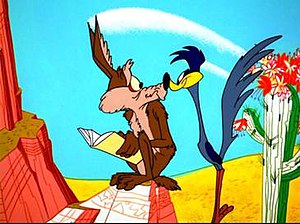 The duo as seen in To Beep or Not to Beep (1963) | |
| Get-go appearance | Fast and Furry-ous (1949) |
| Created by | Chuck Jones |
| Voiced by | Wile E. Coyote: Mel Blanc (1952–1989) Joe Alaskey (1990–2001)[1] Bob Bergen (1998)[2] [3] Dee Bradley Baker (2003)[4] Maurice LaMarche (2008)[5] James Arnold Taylor (2014)[6] JP Karliak (2015–2020)[7] Eric Bauza (2018) Keith Ferguson (2022–nowadays) The Road Runner: Paul Julian (1949–1994, 1996–present; song athenaeum only)[8] Mel Blanc (1964, 1973–1974)[ix] [10] [11] Joe Alaskey (2008)[1] Eric Bauza (2018) (meet below) |
| In-universe information | |
| Species | Wile E. Coyote: Coyote The Road Runner: Greater Roadrunner |
| Gender | Male (both) |
Wile Due east. Coyote and the Road Runner are a duo of drawing characters from the Looney Tunes series of blithe cartoons, first appearing in 1949 in the theatrical cartoon brusque Fast and Furry-ous. In each episode, the cunning, devious and constantly hungry coyote repeatedly attempts to catch and subsequently eat the Route Runner, but is successful in catching the Route Runner (simply non eating it) on merely extremely rare occasions.[12] Instead of his animal instincts, the coyote uses absurdly complex contraptions (generally in the fashion of Rube Goldberg) to attempt to take hold of his casualty, which comically backfire, with the coyote often getting injured in slapstick fashion. Many of the items for these contrivances are mail-ordered from a variety of companies unsaid to be part of the Acme Corporation.
One running gag involves the coyote trying, in vain, to shield himself with a niggling parasol against a slap-up falling bedrock that is well-nigh to trounce him. Some other involves him falling from high cliffs, after momentarily beingness suspended in midair—every bit if the fall is delayed until he realizes that there is zippo below him. The rest of the scene, shot from a bird's-eye view, shows him falling into a canyon so deep that his figure is eventually lost to sight, with only a modest puff of dust indicating his touch on. The coyote is notably a brilliant creative person, capable of quickly painting incredibly lifelike renderings of such things every bit tunnels and roadside scenes, in farther (and equally futile) attempts to deceive the bird.
The characters were created for Warner Bros. in 1948 by animation director Chuck Jones and writer Michael Maltese, with Maltese also setting the template for their adventures. The characters star in a long-running series of theatrical drawing shorts (the first 16 of which were written by Maltese) and occasional made-for-television cartoons. Originally meant to parody chase-drawing characters like Tom and Jerry,[13] they became popular in their ain correct.
The coyote appears separately every bit an occasional antagonist of Bugs Bunny in five shorts from 1952 to 1963: Operation: Rabbit, To Hare Is Human, Rabbit's Feat, Compressed Hare, and Hare-Breadth Hurry. While he is more often than not silent in the Wile E. Coyote – Road Runner shorts, he speaks with a refined accent in these solo outings (except for Hare-Latitude Hurry), beginning with 1952'southward Functioning: Rabbit, introducing himself as "Wile E. Coyote, Genius", voiced past Mel Blanc.[14] The Route Runner vocalizes only with his signature "beep, beep" sound, recorded by Paul Julian and an accompanying "popping-cork" tongue sound.[15]
By 2020 l cartoons had been made featuring the characters (including the four CGI shorts), the majority by creator Chuck Jones.
Television Guide included Wile E. Coyote in its 2013 list of "The 60 Nastiest Villains of All Time".[16]
Cosmos [edit]
Jones based the coyote on Mark Twain's book Roughing Information technology,[17] in which Twain described the coyote equally "a long, slim, sick and sorry-looking skeleton" that is "a living, breathing allegory of Want. He is ever hungry." Jones said he created the Wile E. Coyote-Road Runner cartoons as a parody of traditional "cat and mouse" cartoons such as MGM'southward Tom and Jerry.[18] Jones modelled the coyote'due south appearance on fellow animator Ken Harris.[19]
The coyote'south proper name of Wile East. is a pun of the word "wily." The "Due east" stands for "Ethelbert" in one consequence of a Looney Tunes comic book.[xx] The coyote's surname is routinely pronounced with a long "e" ( ky-OH-tee), just in one cartoon brusque, To Hare Is Human, Wile E. is heard pronouncing it with a diphthong ( ky-OH-tay). Early model sheets for the character prior to his initial appearance (in Fast and Hirsuite-ous) identified him as "Don Coyote", a pun on Don Quixote.[21]
The Road Runner's "beep, beep sound" was inspired past background artist Paul Julian's imitation of a car horn.[22] Julian voiced the diverse recordings of the phrase used throughout the Road Runner cartoons, although on-screen he was uncredited for his work. According to animation historian Michael Barrier, Julian'due south preferred spelling of the sound effect was either "hmeep hmeep"[23] or "mweep, mweep".[24]
Listing of cartoons [edit]
The serial consists of:
- 50 shorts, by and large about 6 to seven minutes long, but including four spider web cartoons which are "three-minute, three-dimensional cartoons in widescreen (scope)".[25]
- One one-half-hour special released theatrically (26 minutes).
- One feature-length picture show that combines live action and blitheness
| # | Release date | Championship | Duration | Credits | Acme Corporation devices used | Books studied | Amount of gags | |
|---|---|---|---|---|---|---|---|---|
| Story/writing | Management | |||||||
| i | September 17, 1949 (1949-09-17) | Fast and Hirsuite-ous | 6:55 | Michael Maltese | Charles M. Jones | Peak Super Outfit | 12 gags | |
| 2 | May 24, 1952 (1952-05-24) | Beep, Beep | half dozen:45 | Michael Maltese | Charles M. Jones | Aspirin, Matches, Rocket-Powered Roller Skates | ||
| 3 | August 23, 1952 (1952-08-23) | Going! Going! Gosh! | 6:25 | Michael Maltese | Charles M. Jones | An anvil, a weather balloon, a street cleaner's bin, and a fan | ||
| 4 | September xix, 1953 (1953-09-nineteen) | Zipping Along | half dozen:55 | Michael Maltese | Charles 1000. Jones | Behemothic Kite Kit, Bomb, Detonator, Nitroglycerin, Bird Seed | "Hypnotism Self-Taught" by Hershenburger | |
| 5 | Baronial 14, 1954 (1954-08-14) | Terminate! Wait! And Hasten! | 7:00 | Michael Maltese | Charles G. Jones | Bird Seed, Triple Strength Fortified Leg Muscle Vitamins | "How to Build a Burmese Tiger Trap" | |
| 6 | April thirty, 1955 (1955-04-30) | Set, Set, Zoom! | 6:55 | Michael Maltese | Charles Thousand. Jones | Gum, Female person Road-Runner Costume | ||
| vii | December ten, 1955 (1955-12-10) | Guided Muscle | 6:forty | Michael Maltese | Charles M. Jones | Top Grease | "How to Tar and Feather a Roadrunner (10th printing)" | |
| eight | May 5, 1956 (1956-05-05) | Gee Whiz-z-z-z-z-z-z | six:35 | Michael Maltese | Charles Thousand. Jones | Peak Triple Strength Battleship Steel Armor Plate, ACME Batman's Outfit, Rubber Ring, Anvil, Jet Bike (Made with Iron Handle Bars and a Jet Motor) | ||
| ix | November 10, 1956 (1956-11-10) | There They Go-Go-Go! | vi:35 | Michael Maltese | Chuck Jones | No Summit branded devices used | ||
| ten | January 26, 1957 (1957-01-26) | Scrambled Aches | vi:50 | Michael Maltese | Chuck Jones | ACME Dehydrated Boulders, Outboard Steam Roller | ||
| xi | September 14, 1957 (1957-09-14) | Zoom and Bored | 6:fifteen | Michael Maltese | Chuck Jones | ACME Bumblebees | ||
| 12 | Apr 12, 1958 (1958-04-12) | Whoa, Be-Gone! | half dozen:10 | Michael Maltese | Chuck Jones | Tornado Kit, Condom Band (For Tripping Route-Runners), Water Pistol | ||
| 13 | October 11, 1958 (1958-ten-11) | Hook, Line and Stinker | 5:55 | Michael Maltese | Chuck Jones | Bird Seed | ||
| 14 | December 6, 1958 (1958-12-06) | Hip Hip-Hurry! | 6:13 | Michael Maltese | Chuck Jones | How-do-you-do-Speed Tonic, Mouse Snare | ||
| 15 | May 9, 1959 (1959-05-09) | Hot-Rod and Reel! | 6:25 | Michael Maltese | Chuck Jones | Jet-Propelled Pogo Stick, Jet-Propelled Unicycle | ||
| 16 | October 10, 1959 (1959-10-ten) | Wild About Hurry | 6:45 | Michael Maltese | Chuck Jones | Giant Rubberband Rubber Band, 5 Miles of Railroad Track, Rocket Sled, Bird Seed, Iron Pellets, Indestructo Steel Ball | ||
| 17 | Jan nine, 1960 (1960-01-09) | Fastest with the Mostest | 7:20 | Michael Maltese (uncredited) | Chuck Jones | Airship Basket, Balloon | 4 gags | |
| xviii | October viii, 1960 (1960-x-08) | Hopalong Casualty | 6:05 | Chuck Jones | Chuck Jones | Christmas Packaging Automobile, Convulsion Pills | ||
| nineteen | January 21, 1961 (1961-01-21) | Zip 'N Snort | 5:50 | Chuck Jones | Chuck Jones | Iron Pellets, Bird Seed, Axle Grease | ||
| 20 | June 3, 1961 (1961-06-03) | Lickety-Splat | 6:xx | Chuck Jones | Chuck Jones, Abe Levitow | Roller skis, Boomerang | ||
| 21 | Nov 11, 1961 (1961-xi-11) | Beep Prepared | 6:00 | John Dunn, Chuck Jones | Chuck Jones, Maurice Noble | ACME Iron Bird Seed, Fiddling-Behemothic Do-It-Yourself Rocket Sled | ||
| Film | June 2, 1962 (1962-06-02) | Adventures of the Road Runner | 26:00 | John Dunn, Chuck Jones, Michael Maltese [26] | Chuck Jones, Maurice Noble, Tom Ray [26] | Pinnacle Batman's Outfit | ||
| 22 | June 30, 1962 (1962-06-30) | Zoom at the Tiptop | 6:30 | Chuck Jones | Chuck Jones, Maurice Noble | Bird seed, instant icicle-maker, boomerang | half dozen gags | |
| 23 | December 28, 1963 (1963-12-28) | To Beep or Not to Beep 1 | 6:35 | John Dunn, Chuck Jones | Chuck Jones, Maurice Noble | |||
| 24 | June 6, 1964 (1964-06-06) | War and Pieces | vi:twoscore | John Dunn | Chuck Jones, Maurice Noble | Invisible Paint | ||
| 25 | January 1, 1965 (1965-01-01) | Zip Null Hooray! 2 | vi:15 | John Dunn | Chuck Jones, Maurice Noble | One-gag, actually, although it includes footage from previous shorts | ||
| 26 | Feb 1, 1965 (1965-02-01) | Road Runner a Go-Become 2 | half-dozen:05 | John Dunn | Chuck Jones, Maurice Noble | None, although Wile E. Coyote does study a film | One-gag, actually, although it includes footage from previous shorts | |
| 27 | Feb 27, 1965 (1965-02-27) | The Wild Hunt | 6:thirty | Friz Freleng | Friz Freleng, Hawley Pratt | Iron Pellets, Bird Seed, Cheese | ||
| 28 | July 31, 1965 (1965-07-31) | Rushing Roulette | half dozen:twenty | David Detiege | Robert McKimson | Sproing Boots | ||
| 29 | Baronial 21, 1965 (1965-08-21) | Run, Run, Sweet Road Runner | 6:00 | Rudy Larriva | Rudy Larriva | Lightning Rod | 4 gags | |
| xxx | September xviii, 1965 (1965-09-18) | Tired and Feathered | half dozen:20 | Rudy Larriva | Rudy Larriva | Dynamite, Assorted Washers | "Birds and their Habitat" | 4 gags |
| 31 | October 9, 1965 (1965-10-09) | Boulder Wham! | 6:30 | Len Janson | Rudy Larriva | Deluxe Howdy-Bounce Trampoline Kit | "Hypnotism for Beginners" | |
| 32 | Oct 30, 1965 (1965-10-30) | Just Plane Beep | 6:45 | Don Jurwich | Rudy Larriva | War Surplus Biplane | Untitled flight educational activity book | |
| 33 | November 13, 1965 (1965-xi-13) | Hairied and Hurried | 6:45 | Nick Bennion | Rudy Larriva | Snow Machine, Magnetic Gun, Exercise Bombs, Super Bomb, Kit | ||
| 34 | December xi, 1965 (1965-12-11) | Highway Runnery | 6:45 | Al Bertino | Rudy Larriva | |||
| 35 | December 25, 1965 (1965-12-25) | Chaser on the Rocks | six:45 | Tom Dagenais | Rudy Larriva | |||
| 36 | January eight, 1966 (1966-01-08) | Shot and Bothered | 6:30 | Nick Bennion | Rudy Larriva | Suction Cups | ||
| 37 | January 29, 1966 (1966-01-29) | Out and Out Rout | vi:00 | Dale Hale | Rudy Larriva | No Elevation labeled devices used | "Hunting Birds", "The History of Speed", "How to Sail" | |
| 38 | February xix, 1966 (1966-02-nineteen) | The Solid Tin Coyote | 6:15 | Don Jurwich | Rudy Larriva | |||
| 39 | March 12, 1966 (1966-03-12) | Clippety Clobbered | vi:15 | Tom Dagenais | Rudy Larriva | |||
| forty | Nov 5, 1966 (1966-11-05) | Carbohydrate and Spies | half dozen:twenty | Tom Dagenais | Robert McKimson | Exercise-it-Yourself Kit Remote Command Missile-Bombs | ||
| 41 | November 27, 1979 (1979-xi-27) | Freeze Frame | six:05 | John West. Dunn Chuck Jones | Chuck Jones | Instant Snowfall Maker, Speed Skates, Jet-Propelled Skis, Dog Sled, 92 lb. Dogs, Rocking Horse, Road-Runner Lasso | "Everything You Ever Wanted To Know About Road Runners (Just Were Afraid To Ask)" | |
| 42 | May 21, 1980 (1980-05-21) | Soup or Sonic | 9:x | Chuck Jones | Chuck Jones, Phil Monroe | Frisbee Disc, Little-Behemothic Fire Crackers, Giant Fly Trap, Explosive Tennis Assurance | ||
| 43 | Dec 21, 1994 (1994-12-21) | Chariots of Fur iii | 7:00 | Chuck Jones | Chuck Jones | Giant Mouse Trap, Instant Route, Cactus Costume, Lightning Bolts | ||
| 44 | December 30, 2000 (2000-12-thirty) | Fiddling Go Beep | 7:55 | Kathleen Helppie-Shipley, Earl Kress | Fasten Brandt | Annoy Trap, Stretch Hamstring, Jack in the Box with a Boxing Glove and a Big Trike with Aqua Rockets | ||
| 45 | November i, 2003 (2003-11-01) | The Whizzard of Ow | vii:00 | Chris Kelly | Bret Haaland | Book of Magic, Flying Broom, Bomb, Clear Paint | "Superlative Volume of Magic" | |
| Motion picture | November 14, 2003 (2003-11-14) | Looney Tunes: Back in Action | 91:00 | Larry Doyle | Joe Dante | Missile Launcher, Train of Death, Anvil | ||
| 46 | July 30, 2010 (2010-07-30) | Coyote Falls 3 | two:59 | Tom Sheppard[27] | Matthew O'Callaghan | Bird Seed, Bungee Cord | ||
| 47 | September 24, 2010 (2010-09-24) | Fur of Flying 3 | 3:03[28] | Tom Sheppard | Matthew O'Callaghan[28] | Tiptop Bonnie Bike, Acme Mega-Motor, Height Football Helmet, Summit Ceiling Fan | ||
| 48 | December 17, 2010 (2010-12-17) | Rabid Rider 3 | 3:07 | Tom Sheppard | Matthew O'Callaghan | Acme Hyper-Sonic Send | ||
| 49 | June x, 2014 | Flash in the Pain [29] [xxx] | three:13 | Tom Sheppard | Matthew O'Callaghan | Acme Molecular Transporter | ||
| 50 | May 27, 2020 | Cactus if you can [31] | two:11 | Michael Ruocco David Gemmill | David Gemmill | Acme Super Suc | ||
ane Re-edited from Adventures of the Route Runner by Chuck Jones and with new music direction from Bill Lava
2 Re-edited from Adventures of the Route Runner by DePatie–Freleng Enterprises
3 These cartoons were each shown with a characteristic-length movie. Chariots of Fur was shown with Richie Rich, Coyote Falls was shown with Cats & Dogs: The Revenge of Kitty Galore,[25] Fur of Flight was shown with Legend of the Guardians: The Owls of Ga'Hoole,[32] and Rabid Passenger was shown with Yogi Bear. Flash in the Pain was shown at the Annecy International Animated Picture Festival on June x, 2014.[29] [30]
Scenery [edit]
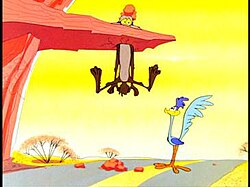
The desert scenery in the first three Road Runner cartoons, Fast and Furry-ous (1949), Beep, Beep (1952), and Going! Going! Gosh! (besides 1952), was designed by Robert Gribbroek and was quite realistic. In most later cartoons, the scenery was designed by Maurice Noble and was far more abstract.
Acme Corporation [edit]
Wile Due east. Coyote often obtains diverse circuitous and ludicrous devices from a mail-order company, the fictitious Acme Corporation, which he hopes will help him catch the Road Runner. The devices invariably fail in improbable and spectacular fashion.
In August, September and October 1982, the National Lampoon published a 3-part serial chronicling the lawsuit Wile Eastward. filed against the Height Corporation over the faulty items they sold him in his pursuit of the Road Runner. Even though the Road Runner appeared as a witness for the plaintiff, the coyote still lost the suit.[33]
Laws and rules [edit]

In his book Chuck Amuck: The Life and Times of an Animated Cartoonist,[34] Chuck Jones claimed that he and the artists behind the Road Runner and Wile E. Coyote cartoons adhered to some simple but strict rules:
- "The Road Runner cannot harm the Coyote except by going 'Beep-Beep!'" This merely applies to straight harm; still, the Road Runner is able to indirectly harm Wile East. One of the most mutual instances of indirect harm was done with a startling "Beep-Beep" that ends upwardly either sending Wile E. off a cliff or upwards in the air and through a rock above him. Rule i was broken twice, one time in Clippety Clobbered when the Route Runner drops a boulder on the coyote afterward painting it with "invisible paint", and again in the episode 'Out and Out Rout' when the Route Runner runs over the Coyote with a steam roller. This rule has besides been broken in several CGI shorts from The Looney Tunes Prove. Plus, "Fast and Furry-ous" was earlier this rule. Unless y'all count that one, the offset instance of this rule being broken is "Hip Hip-Bustle!", where he trips Wile E. Coyote. Still, the rule wouldn't be broken over again until "Rushing Roulette". He would harm him again, the final fourth dimension being the ending of 2003's "The Whizzard of Ow", discounting the CGI shorts that weren't theatrical. Surprisingly, none of the shorts gave Wile E. straight harm from Road Runner were theatrical, although the shorts seen on The Looney Tunes Show are a unlike matter.
- "No outside force can harm the Coyote — only his own ineptitude or the failure of the Acme products." Trains and trucks were the exceptions from time to time, also equally the desert environment (boulders, cacti, etc.)
- "The Coyote could stop anytime — if he were not a fanatic. (Repeat: 'A fanatic is one who redoubles his attempt when he has forgotten his aim.' — George Santayana)."
- "No dialogue ever, except 'Beep-Beep!'" Various onomatopoeic exclamations (such equally yelping in hurting) are seemingly not considered dialogue. This rule was violated in some cartoons, such as in Zoom at the Top where the Coyote says the give-and-take "Ouch." after he gets hurt in a bear trap, as well as in shorts such as Adventures of the Road Runner, which do not follow the standard formula. Typically, Wile E. Coyote communicates past belongings up i or more signs that read such phrases as "In Heaven'southward name… what am I doing?", "How about catastrophe this cartoon earlier I hit?" and "Okay, wise guys, you always wanted me to take hold of him / At present what do I do?", among others. The Road Runner sometimes does this too, having used signs with such phrases equally "Route Runners can't read", "Road Runners tin't read and don't drink", "I've already got a date", "Road Runners already have feathers", and "I simply don't have the centre"/"Good day!", amidst others. In one particular cartoon, Fastest with the Mostest, the Route Runner responds to the coyote'south sign with his own; later the coyote fails some other effort at communicable the Road Runner due to cartoon physics, he holds up a sign that reads "I wouldn't heed - except that he defies the police force of gravity!" In respond, the Road Runner holds upwardly a sign that reads "Sure - just I never studied police!".
- "The Route Runner must stay on the road — otherwise, logically, he would not be called a Road Runner." This dominion was cleaved in several shorts, including cactus patches, mines, cliff edges, mountain tops and railways.
- "All action must be bars to the natural environment of the two characters — the southwest American desert." This rule was cleaved in Freeze Frame, when Wile E. discovers that Road Runners detest snow and water ice, chases the Route Runner onto a snowy tiptop, and devises various traps in that location, which, plainly, was correct next to the desert. Much to Wile E.'s surprise, the Road Runner did non testify any sign of abhorrence. In another episode State of war and Pieces the Coyote tries to grab the Route Runner by riding a rocket; instead he ends up going through the ground and ends upwards in Cathay. He sees a Chinese Road runner and tries to grab him but ends upwardly running into a gong. The Coyote falls through the hole all the style back to the American Southwest and faints. The Chinese Road Runner come up through the hole and Beep Beeps in Chinese which modify into english letters "The End"
- "All materials tools, weapons, or mechanical conveniences must be obtained from the Acme Corporation." All the same, there have been instances in which Wile E. utilizes products not obtained from Peak; in Rushing Roulette, the Coyote uses AJAX Stix-All glue. In Goose egg 'N Snort, bated from the Acme Iron Pellets, Wile E. also had a box of AJAX Bird Seed. In Fast and Hirsuite-ous, even though one detail, the Super Outfit, was from Height, for some reason the Jet-Propelled Tennis Shoes were from "Fleet-Anxiety". On one occasion, he uses a manual: How to Build a Burmese Tiger Trap (though the publisher is not indicated), hoping to catch the Road Runner. To his shock, the trap works precisely as promised, and actually does catch a Burmese tiger ("Surprisibus! Surprisibus!") who attacks Wile Eastward. {A like gag to this as well happened with Ralph Wolf's tiger Trap]. In To Beep or Not to Beep the coyote repeatedly tries to use a catapult to drop a boulder on the speedy bird, just the catapult continually backfires on him; at the cease of the short, the catapult is revealed to be made past the "Road Runner Manufacturing Company — Phoenix * Taos * Santa Fe * Flagstaff and Elsewhere""! In Route Runner a Go-Get the Coyote uses a pattern of a Greco-Roman catapult to build a giant catapult to try to grab the Road Runner but it backfires every time. The injured Coyote strikes the blueprint with his pikestaff and is cloberbed by a stone of the blueprint catapult; at the end of the short, the camera and so zooms downward to a characterization on the blueprint, revealing information technology to be made past the "Road Runner Blue-Print Co. — Phoenix * Taos * Santa Iron * Flagstaff and Elsewhere".
- "Whenever possible, brand gravity the Coyote's greatest enemy." For example, falling off a cliff.
- "The Coyote is e'er more humiliated than harmed by his failures."
These rules were not always followed, and in an interview[15] years afterward the series was made, principal writer of the original 16 episodes Michael Maltese stated he had never heard of these or whatsoever "rules" and dismissed them equally "post production observation".
Equally in other cartoons, the Route Runner and the coyote follow certain laws of cartoon physics, peculiar to an animation universe. Some examples:[ citation needed ]
- Animation vs. Reality Mixing: the Road Runner has the ability to enter the painted prototype of a cavern, while the coyote cannot (unless there is an opening through which he can autumn). Sometimes, even so, this is reversed, and the Road Runner can burst through a painting of a broken span and proceed on his way, while the coyote will instead enter the painting and fall down the precipice of the cliff where the bridge is out.
- Gravity: sometimes the coyote is immune to hang in mid-air until he realizes that he is about to plummet into a chasm (a procedure occasionally referred to elsewhere as Route-Runnering or a Wile East. Coyote moment). The coyote can overtake rocks (or cannons) which fall earlier than he does, and stop up existence squashed by them. If a chase sequence runs over the border of a cliff, the Road Runner is not affected by gravity, whereas the coyote will exist subject to normal Earth gravity and eventually autumn to the ground below. The Road Runner tin besides stand upon a platform suspended in midair (such as a hole cut out from a bridge by the coyote) where gravity instead causes everything but that one cutting-out surface area to collapse to the ground.
- The Route Runner is able to run fast enough to go through fourth dimension.
- If the coyote uses an explosive (commonly dynamite) that is triggered by a mechanism that is supposed to force the explosive in a forrard motion toward its target, the actual machinery itself will shoot frontwards, leaving the explosive behind to detonate in the coyote's face. On occasion, the explosive sometimes explodes either as well early on or too tardily with the Coyote beingness defenseless in the explosion (this gag likewise appeared in other Looney Tunes series).
- Delayed Reaction: (a) a complex apparatus that is supposed to propel an object like a boulder or steel ball frontwards, or trigger a trap, will not work on the Road Runner, simply always does so perfectly on the coyote - when he inspects it after its failure to ensnare the Road Runner. (b) the Road Runner can leap up and down on the trigger of a large fauna trap and eat the intended trap trigger bird seed off information technology and leave unharmed without setting off the trap; but when the coyote places the tiniest droplet of oil on the trigger, the trap snaps close on him without fail.
- On other occasions, the coyote dons an exquisite Height costume or propulsion device that briefly allows him to take hold of upwards to the Road Runner, only ultimately always results in him losing track of his proximity to large cliffs or walls, and while the Route Runner darts around an extremely abrupt turn near a cliff, defying physics, the coyote succumbs to physics and will rocket correct over the border and plummet spectacularly to the ground.
- In what might be chosen cartoon biology, the Road Runner ever runs faster than the coyote, whilst in reality, a coyote can outrun a greater roadrunner.[35]
Both animals were typically introduced in a similar fashion; the activity would slow to a halt, and a caption would appear with both their mutual name and a mock genus/species name in pseudo-Latin (for example, in Zoom at the Top, the Route Runner was classified equally "Disappearialis Quickius", while the coyote was identified equally "Overconfidentii Vulgaris").
Later on cartoons [edit]
The original Chuck Jones productions ended in 1963 after Jack L. Warner airtight the Warner Bros. animation studio. War and Pieces, the last Wile Eastward. Coyote/Road Runner short directed by Jones, was released on June half-dozen, 1964. Past that fourth dimension, David H. DePatie and managing director Friz Freleng had formed DePatie–Freleng Enterprises, moved into the facility merely emptied past Warner, and signed a license with Warner Bros. to produce cartoons for the big studio to distribute.
Their starting time cartoon to feature the Road Runner was The Wild Chase, directed by Freleng in 1965. The premise was a race betwixt the bird and "the fastest mouse in all United mexican states," Speedy Gonzales, with the coyote and Sylvester the Cat each trying to make a meal out of their corresponding usual targets. Much of the textile was animation rotoscoped from before Road Runner and Speedy Gonzales shorts, with the other characters added in.
In total, DePatie-Freleng produced xiv Road Runner cartoons, 2 of which were directed by Robert McKimson (Rushing Roulette (1965) and Sugar and Spies (1966)). Xi of these shorts, directed by Rudy Larriva (often referred to as the "Larriva Eleven"), were subcontracted to Format Films and suffered from severe upkeep cuts; due to a significant driblet in the number of frames used per second in animation, the "Larriva Eleven" were somewhat cheap-looking and jerky. The music was also of poorer quality than the older features; this was a by-product of music director Nib Lava (who had replaced the recently deceased Milt Franklyn three years prior) being relegated to the employ of pre-composed music cues - due to the previously mentioned budget cuts - rather than a proper score, as heard with The Wild Chase, Rushing Roulette, and Run Run, Sweet Road Runner (the third being the only one of the "Larriva Eleven" to have a proper score). These 11 shorts have been considered inferior to the other Golden Age shorts, garnering mixed to poor reviews from critics. In Of Mice and Magic, Leonard Maltin calls the series "witless in every sense of the word." In improver, except for the planet Earth scene at the tail finish of "Highway Runnery", at that place was simply one clip of the coyote's fall to the ground, used over and over over again. Jones' previously described "laws" for the characters were not followed with whatsoever pregnant fidelity, nor were Latin phrases used when introducing the characters.
Spin-offs [edit]

In another series of Warner Bros. Looney Tunes cartoons, Chuck Jones used the character design (model sheets and personality) of Wile E. Coyote as "Ralph Wolf". In this series, Ralph continually attempts to steal sheep from a flock being guarded past the eternally vigilant Sam Sheepdog. As with the Route Runner and Wile E. Coyote serial, Ralph Wolf uses all sorts of wild inventions and schemes to steal the sheep, but he is continually foiled by the sheepdog. In a motion seen by many every bit a self-referential gag, Ralph Wolf continually tries to steal the sheep non considering he is a fanatic (as Wile E. Coyote was), but because it is his chore. In every drawing, he and Sam Sheepdog punch a timeclock and substitution pleasantries, become to work, cease what they are doing to take a lunch pause, go back to work and pick up right where they left off, and clock out to go abode for the twenty-four hour period and substitution pleasantries again, all according to a manufactory-like bravado whistle. The most obvious difference betwixt the coyote and the wolf, aside from their locales, is that Wile E. has a blackness nose and Ralph has a red nose.
Comic books [edit]
Wile Due east. Coyote was called Kelsey Coyote in his comic book debut, a Henery Militarist story in Looney Tunes and Merrie Melodies #91 (May 1949). He only fabricated a couple of other appearances at this time and did non have his official name yet, as it was not used until 1952 (in Operation: Rabbit, his second appearance).[36]
The first appearance of the Road Runner in a comic volume was in Bugs Bunny Vacation Funnies #8 (August 1958) published by Dell Comics. The feature is titled "Beep Beep the Road Runner" and the story "Desert Dessert". It presents itself as the first meeting between Beep Beep and Wile E. (whose mailbox reads "Wile E. Coyote, Inventor and Genius"), and introduces the Road Runner's wife, Matilda, and their three newly hatched sons (though Matilda before long disappeared from the comics). This story established the convention that the Road Runner family talked in rhyme, a convention that also appeared in early children's book adaptations of the cartoons.
Dell initially published a dedicated "Beep Beep the Route Runner" comic equally part of Four Color Comics #918, 1008, and 1046 before launching a separate series for the character numbered #4–14 (1960–1962), with the three effort-out bug counted every bit the showtime iii numbers. Afterwards a hiatus, Gold Key Comics took over the grapheme with problems #1–88 (1966–1984). During the 1960s, the artwork was done past Pete Alvarado and Phil DeLara; from 1966 to 1969, the Gold Cardinal issues consisted of Dell reprints. Afterward, new stories began to appear, initially drawn by Alvarado and De Lara earlier Jack Manning became the principal creative person for the title. New and reprinted Beep Beep stories also appeared in Golden Comics Digest and Gold Key's revival of Looney Tunes in the 1970s. During this flow, Wile E.'s middle name was revealed to be "Ethelbert"[20] in the story "The Greatest of Eastward'southward" in result #53 (encompass-dated September 1975) of Gold Key Comics' licensed comic book Beep Beep the Road Runner.[37]
The Route Runner and Wile E. Coyote as well brand appearances in the DC Comics Looney Tunes championship. Wile E. was able to speak in some of his appearances in the DC comics.
In 2017, DC Comics featured a Looney Tunes and DC Comics crossovers that reimagined the characters in a darker style. The Road Runner and Wile E. Coyote had a crossover with the intergalactic bounty hunter Lobo in Lobo/Road Runner Special #1. In this version, the Road Runner, Wile E., and other Looney Tunes characters are reimagined every bit standard animals who were experimented upon with alien DNA at Acme to transform them into their cartoon forms. In the back-upwards story, done in more traditional cartoon fashion, Lobo tries to chase downwards the Road Runner, but is express past Bugs to exist more kid-friendly in his language and approach.[38] [39]
Television [edit]
The Road Runner and the coyote appeared on Saturday mornings equally the stars of their own TV series, The Road Runner Evidence, from September 1966 to September 1968, on CBS. At this time it was merged with The Bugs Bunny Prove to become The Bugs Bunny and Route Runner Show, running from 1968 to 1985. The testify was afterwards seen on ABC until 2000, and on Global until 2001.
In the 1970s, Chuck Jones directed some Wile E. Coyote/Route Runner brusk films for the educational children'south TV series The Electric Company. These short cartoons used the coyote and the Road Runner to brandish words for children to read, but the cartoons themselves are a refreshing return to Jones' celebrity days.
In 1979, Freeze Frame, in which Jones moved the chase from the desert to snow-covered mountains, was seen every bit role of Bugs Bunny's Looney Christmas Tales.
At the end of Bugs Bunny's Portrait of the Creative person as a Young Bunny (the initial sequence of Chuck Jones' Television special Bugs Bunny's Bustin' Out All Over), Bugs mentions to the audition that he and Elmer may have been the starting time pair of characters to have chase scenes in these cartoons, but and then a pint-sized infant Wile E. Coyote (wearing a diaper and holding a small pocketknife and fork) runs right in front of Bugs, chasing a gold-colored, mostly unhatched (except for the tail, which is sticking out) Route Runner egg, which is running rapidly while some loftier-pitched "Beep, beep" noises can be heard. This was followed by the total-fledged Road Runner/Wile E. Coyote short Soup or Sonic. Earlier in that story, while child Elmer was falling from a cliff, Wile E. Coyote'southward adult cocky tells him to move over and get out falling to people who know how to practice it and then he falls, followed by Elmer.
In the 1980s, ABC began showing many Warner Bros. shorts, but in highly edited form. Many scenes integral to the stories were taken out, including scenes in which Wile East. Coyote landed at the lesser of the canyon subsequently having fallen from a cliff, or had a boulder or anvil actually brand contact with him. In almost all WB animated features, scenes where a character's confront was burnt and black, some idea resembling blackface, were removed, as were animated characters smoking cigarettes[ citation needed ]. Some cigar smoking scenes were left in. The unedited versions of these shorts (with the exception of ones with blackface) were not seen again until Cartoon Network, and after Boomerang, began showing them again in the 1990s and early 2000s. Since the release of the WB library of cartoons on DVD, the cartoons gradually disappeared from television, presumably to increment sales of the DVDs. However, Cartoon Network began to air them again in 2011, coinciding with the premiere of The Looney Tunes Bear witness (2011), and the shorts were afterwards moved to Boomerang, where they accept remained to this solar day.
Wile Due east. Coyote and the Road Runner appeared in several episodes of Tiny Toon Adventures. In this series, Wile Eastward. (voiced in the Jim Reardon episode "Piece of Mind" by Joe Alaskey) was the dean of Acme Looniversity and the mentor of Calamity Coyote. The Road Runner'south protégé in this serial was Little Beeper. In the episode "Piece of Heed", Wile E. narrates the life story of Calamity while Calamity is falling from the height of a alpine skyscraper. In the direct-to-video film Tiny Toon Adventures: How I Spent My Vacation, the Road Runner finally gets a taste of humiliation by getting run over past a mail truck that "brakes for coyotes."
The two were as well seen in cameos in Animaniacs. They were together in two Slappy Squirrel cartoons: "Bumbie's Mom" and "Little Erstwhile Slappy from Pasadena". In the latter, the Road Runner gets another sense of taste of humiliation when he is out-run by Slappy's car, and holds upwards a sign saying "I quit" — immediately afterward, Buttons, who was launched into the air during a previous gag, lands squarely on height of him. Wile Due east. appears without the bird in a The Wizard of Oz parody, dressed in his batsuit from one brusque, in a twister (tornado) funnel in "Buttons in Ows". Likewise, in the outset of one episode, an artist is seen drawing the Road Runner.
In a Cartoon Network TV advertisement about The Acme 60 minutes, Wile E. Coyote utilized a pair of jet roller skates to catch the Road Runner and (quite surprisingly) did not neglect. While he was cooking his casualty, it was revealed that the roller skates came from a generic brand. The ad said that other make is not the same affair.[ clarification needed ] [ citation needed ]
The Road Runner appears in an episode of the 1991 series Taz-Mania, in which Taz grabs him by the leg and gets gear up to eat him, until the two gators are set up to capture Taz, so he lets the Route Runner go. In another episode of Taz-Mania, the Road Runner cartoons are parodied, with Taz dressed as the Route Runner and the character Willy Wombat dressed as Wile E. Coyote. Willy tries to catch Taz with Acme Roller Skates merely fails, and Taz even says "Beep, beep".
Wile E. and the Route Runner appeared in their toddler versions in Babe Looney Tunes, but only in songs. Still, they both had made a cameo in the episode "Are We There Yet?", where the Road Runner was seen out the window of Floyd'due south car with Wile E. chasing him.
Wile E. Coyote had a cameo as the true identity of an alien hunter (a parody of Predator) in the Duck Dodgers episode "Grand-9 Quarry," voiced past Dee Bradley Baker. In that episode, he was hunting Martian Commander 10-two and K-nine. He is also temporary every bit a member of Agent Roboto's Legion of Duck Doom from the previous season in another episode.
In Loonatics Unleashed, Wile E. Coyote and the Road Runner'southward 28th century descendants are Tech E. Coyote (voiced by Kevin Michael Richardson) and Rev Runner (voiced by Rob Paulsen). Tech E. Coyote was the tech expert of the Loonatics (influenced past the past cartoons with many of the machines ordered by Wile E. from Peak), and has magnetic hands and the power to molecularly regenerate himself (influenced past the many times in which Wile E. painfully failed to capture the Road Runner and then was shown to accept miraculously recovered). Tech Due east. Coyote speaks, but does not have a British emphasis as Wile E. Coyote did. Rev Runner is as well able to talk, though extremely rapidly, and tin fly without the apply of jet packs, which are used by other members of the Loonatics. He also has sonic speed, also a have-off of the Road Runner. The pair get on rather well, despite the number of gadgets Tech designs in order to stop Rev from talking; also they have their moments where they do not go along. When friendship is shown information technology is often but from Rev to Tech, not the other way around; this could, nonetheless, be attributed to the fact that Tech has only the barest minimum of social skills. They are both portrayed equally smart, but Tech is the better inventor and at times Rev is shown doing stupid things. References to their ancestors' past are seen in the episode "Family Business organisation" where the other Road Runners are wary of Tech and Tech relives the famous falling gags done in the Wile Due east. Coyote/Road Runner shorts.
The Road Runner and Wile E. Coyote feature in 3D reckoner animated cartoons or cartoon animation in the Drawing Network TV series The Looney Tunes Show. The CGI shorts were simply included in Flavor 1, but Wile E. and the Route Runner even so appeared throughout the series in 2d animation.
Wile E. Coyote also appears in the Tv set series Wabbit, voiced by JP Karliak, in a similar vein to his previous pairings with Bugs Bunny. He appears as Bugs' abrasive know-it-all neighbor who always uses his inventions to compete with Bugs. The Route Runner began making appearances when the series was renamed New Looney Tunes in 2017.
Wile E. Coyote and the Road Runner both appear in their own cartoon shorts in the HBO Max streaming series Looney Tunes Cartoons.
Wile Due east. Coyote and the Road Runner make occasional appearances in the preschool educational series Bugs Bunny Builders. Wile Due east. (voiced by Keith Ferguson) often helps the Looney Builders out with their plans, oftentimes using some of his inventions. [xl]
Wile Due east. Coyote was also in an episode of Nighttime Court (Season vii, Episode 22: Sill Another Day in the Life) in which Approximate Harold T. Stone (Harry Anderson) found him guilty of harassment and told him to leave the poor bird alone.[41]
3-D shorts [edit]
The characters appeared in seven 3-D shorts attached to Warner Bros. features. Three take been screened with features, while the rest serve as segments in season ane of The Looney Tunes Show. A brusk called Flash in the Pain was shown on the spider web in 2014, but was non shown in theaters until 2016, when the movie Storks premiered.
Film [edit]
Warner Bros. is developing a live-action/blitheness hybrid picture show centered on Wile E. Coyote titled Coyote vs. Meridian, produced by Warner Animation Group, with The Lego Batman Pic managing director Chris McKay on board to produce.[42] [43] The film is said to be based on The New Yorker brusque story "Coyote v. Acme" past author Ian Frazier.[44] Published in 1990, the piece imagined a lawsuit brought almost by Wile E. Coyote confronting the Acme Company who provided him with various devices and tools to aid in his pursuit of the Route Runner. The devices frequently malfunctioned, leading to the humorous failures, injuries, and sight gags the Road Runner cartoons are known for.[45] Jon and Josh Silberman were originally set to write the screenplay.[42] On December 18, 2019, information technology was reported that Dave Green volition direct the projection.[43] It was too reported that the project is looking for a new writer, with Jon and Josh Silberman instead co-producing the moving-picture show aslope McKay;[43] notwithstanding, by December 2020, McKay departed the project while Jon and Josh Silberman left their roles as producers and resumed their screenwriting roles, with Samy Burch, Jeremy Slater, and James Gunn likewise writing the film. Gunn will also co-produce the projection aslope Chris DeFaria. It was also announced that the film is scheduled to be released on July 21, 2023.[46] In February 2022, it was appear that John Cena would star in the picture.[47] In March 2022, Will Forte and Lana Condor were added to the cast.[48]
Voice actors [edit]
Wile E. Coyote [edit]
- Mel Blanc (1952–1989)
- Paul Julian (imitating the Road Runner in Zipping Along, Ready, Set, Zoom!, The Route Runner Show bumper and Road Runner's Death Valley Rally)
- Joe Alaskey (Tiny Toon Adventures, Judge Granny [49])[fifty] [1]
- Keith Scott (Spectacular Low-cal and Evidence Illuminanza,[51] [52] The Looney Tunes Radio Show [53] [54])[fifty] [55] [56]
- Bob Bergen (Bugs Bunny's Learning Adventures)[2] [iii]
- Seth MacFarlane (Family Guy, Seth MacFarlane's Cavalcade of Drawing Comedy)[57] [58]
- Dee Bradley Baker (Duck Dodgers)[l] [4]
- Maurice LaMarche (Looney Tunes: Cartoon Conductor)[l] [5]
- Jess Harnell (The Drawn Together Motion picture: The Moving picture!)[59]
- James Arnold Taylor (Scooby Doo and Looney Tunes: Cartoon Universe)[50] [six]
- JP Karliak (New Looney Tunes)[50] [7]
- Martin Starr (Robot Chicken)[lx]
- Eric Bauza (Looney Tunes: World of Mayhem)[50] [61]
- Keith Ferguson (Bugs Bunny Builders)[50]
The Road Runner [edit]
The vox creative person Paul Julian originated the character's voice. Before and after his decease, his vocalization was appearing in various media, for example, in Goggle box series, shorts and video games, such as 2014's Looney Tunes Nuance. In addition, other voice actors have replaced him. These vocalisation actors are:
- Mel Blanc (1964 Greeting Menu Record,[9] The New Adventures of Bugs Bunny (1973), Four More Adventures of Bugs Bunny (1974),[10] Looney Tunes Talking Character Wall Clock[11])
- Keith Scott (Route Runner Roller Coaster commercial,[62] The Looney Tunes Radio Show [53] [54])[63] [55] [56]
- Joe Alaskey (Looney Tunes: Cartoon Conductor)[1]
- Kevin Shinick (Mad)[64]
- Seth Green (Robot Craven)[65]
- Eric Bauza (Looney Tunes: Earth of Mayhem)[63] [61]
Video games [edit]
Several Wile Due east. Coyote and the Road Runner-themed video games accept been produced:
- Route Runner (arcade game by Atari, afterward ported to the Commodore 64, NES, Atari 2600, and several PC platforms)
- Electronic Route Runner (cocky-independent LCD game from Tiger Electronics released in 1990)
- Looney Tunes (Game Male child game by Sunsoft).
- The Bugs Bunny Crazy Castle (NES/Game Boy game by Kemco)
- The Bugs Bunny Crazy Castle ii (Game Male child game by Kemco)
- The Bugs Bunny Birthday Blowout (NES game by Kemco)
- Road Runner's Death Valley Rally (Super NES game by Sunsoft)
- Wile Due east. Coyote's Revenge (Super NES game by Sunsoft)
- Desert Speedtrap (Sega Game Gear and Sega Chief System game past Sega/Probe Software)
- Bugs Bunny: Crazy Castle 3 (Game Boy game by Kemco)
- Desert Demolition (Sega Mega Drive/Genesis game by Sega/BlueSky Software)
- Sheep, Domestic dog, 'n' Wolf (for the original PlayStation and published by Infogrames, actually based on the Ralph Wolf and Sam Sheepdog cartoons, but the Road Runner does make two cameo appearances)
- Looney Tunes B-Brawl (Wile E. is a playable character)
- Space Jam
- Looney Tunes Racing (Wile E. is a playable character. The Road Runner is also seen in the game as a non-playable graphic symbol.)
- Taz Limited (Nintendo 64) game published by Infogrames (Wile E is an antagonist)
- Taz: Wanted (Wile E. appears)
- Looney Tunes: Dorsum in Activity (published by Electronic Arts)
- Looney Tunes Double Pack (published by Majesco Amusement, developed past WayForward Technologies, where "Pinnacle Antics" is the Wile East. Coyote and the Route Runner one-half of the double pack)
- Looney Tunes: Space Race (Wile E. is a playable character)
- Looney Tunes Acme Armory (Wile Due east. has his own level in the PS2 version)
- Looney Tunes: Cartoon Usher
- Looney Tunes Nuance (iOS and Android game)
- Looney Tunes: World of Commotion (iOS and Android game)
In pop culture [edit]
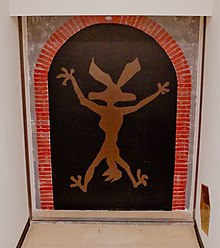
A landscape of Wile E. Coyote smashed into the wall of the Rotch Library at MIT. Due to differences in floor superlative in connected buildings, this hallway unexpectedly ends in a wall.
Wile E. Coyote and the Road Runner have been frequently referenced in popular culture. Some explamples:
In the G.I. Joe: A Existent American Hero episode "Lights! Photographic camera! Cobra!", Shipwreck kicks abroad a coyote before going "Beep Beep".
There are two scenes in Stanley Kubrick's 1980 adaptation of The Shining where Danny Torrance and his mother, Wendy Torrance, are watching the cartoons.
Wile East. Coyote and the Road Runner appeared in the 1988 Touchstone/Amblin film Who Framed Roger Rabbit. They are starting time seen silhouetted by the elevator doors in Toontown, and then in full in the ACME Factory during the terminal scene with other characters.
Wile E. Coyote has appeared twice in Family Guy: his first episode, "I Never Met the Dead Man", depicts him riding in a car with Peter Griffin; when Peter runs over the Road Runner and asks if he hitting "that ostrich", Wile E. tells him to keep going.[66] His second advent was in "PTV", in which Wile E. attempts to become a refund for a giant-sized slingshot at an Peak retailer where Peter works. The DVD-sectional episode "Partial Terms of Endearment" features a gag that parodies the Wile Due east./Road Runner cartoons where Peter lures Lois with gratuitous Grey's Anatomy DVDs (in the vein of Wile E. luring the Road Runner with free bird seed) and attempts to finish her pregnancy by firing a battle glove at her from a crossbow atop a cliff; this fails, and Peter ends up falling off the cliff in Wile East.-fashion.
Wile Due east. Coyote and the Route Runner appeared in Seth MacFarlane'south Cavalcade of Cartoon One-act in the curt "Die, Sugariness Roadrunner, Die". In this short, Wile E. crushes the Road Runner with a large boulder and eats him, but then struggles to find purpose in life, having not trained for anything else other than chasing the Route Runner. Ultimately, later a short-lived chore as a waiter in a local diner, and a suicide attempt (by way of catapulting himself into a mount at close range), Wile East. finally realizes what he is to do with his life, and reveals he is at present an abet for Christianity.
Both Wile Eastward. Coyote and the Road Runner have appeared in Robot Chicken on multiple occasions. One sketch sees Wile E. faking his own suicide and and then torching the Road Runner with a flamethrower when he shows upwards at Wile Due east.'due south "funeral". Some other sketch shows Wile E. teaching a college form on how to get away with murder, using the Road Runner'southward murder every bit an example; the students trace the mail orders for the ACME products used to commit the murder to Wile E., who is executed by electric chair for the criminal offence. Some other sketch sees Wile E. presenting his iconic "fake tunnel" at an art sale, and another reveals why Wile E.'s ACME products always fail - the Summit Corporation is run by multiple Road Runners.
Guitarist Mark Knopfler created a vocal called "Coyote" in homage to the cartoon shows of Wile Eastward. Coyote and the Road Runner on the 2002 album The Ragpicker'due south Dream. The Tom Smith song "Operation: Desert Storm", which won a Pegasus award for Best Fool Song in 1999, is near the unlike crazy ways the coyote'due south plans fail.[67]
Dee Snider, lead singer of the glam metal band Twisted Sister stated in his Congressional testimony before the PRMC hearings on adding Parental Advisory labels in music and music videos, that the music video for the band's signature vocal "We're Not Gonna Take Information technology" was based heavily on the cartoon.[68]
Humorist Ian Frazier created the mock-legal prose piece "Coyote v. Pinnacle",[69] which is included in a book of the same proper noun.[70]
During a scene in The Fatigued Together Pic: The Movie!, the Fatigued Together cast accidentally run over and kill the Route Runner with Foxxy Dear'due south van. Upon noticing this, Wile E. Coyote runs upwards to the Road Runner's corpse and declares "Without you lot, my life really has no meaning", earlier shooting himself with a "Bang!" flag gun.
See also [edit]
- Coyotes in pop civilization
- Coyote (mythology)
- Route Runner Loftier Speed Online
- Calamity Coyote
- Little Beeper
- Plymouth Route Runner
- Arizona Coyotes, an NHL team whose AHL affiliate is the Tucson Roadrunners
References [edit]
- ^ a b c d "Joe Alaskey interview (Tiny Toon Adventures / Looney Tunes / Who Framed Roger Rabbit)". Saturday Morning Rewind. Retrieved June 12, 2021.
Since 1981, over the past 30 years, I've been doing Bugs, Daffy and the other characters. I'm the only guy in the talent pool who has played all of the major characters, including… yes, including Wile E. Coyote and the Route Runner, but also Porky. You take to chase for some of these credits, but I have done them all at 1 point; Hubie and Bertie, and Henery Militarist, all those characters.
- ^ a b "Looney Tunes DVD and Video Guide: VHS: Misc". The Inernet Animation Database . Retrieved November 30, 2021.
- ^ a b "Bugs Bunny'due south Dizzy Seals". Backside The Voice Actors . Retrieved 2020-04-twenty .
- ^ a b "Voice of Alien Hunter in Duck Dodgers". Behind the Phonation Actors . Retrieved 2020-08-21 .
- ^ a b "Vocalism of Wile Eastward. Coyote in Looney Tunes: Cartoon Conductor". Behind the Voice Actors . Retrieved 2020-08-21 .
- ^ a b "Scooby Doo & Looney Tunes Drawing Universe: Adventure". Backside The Voice Actors . Retrieved 2019-10-xxx .
- ^ a b JP Karliak [@jpkarliak] (18 September 2015). "The latest #Wabbit promo has a moment of me every bit Wile E. getting "winded." On #BoomerangTV adjacent month! #SuperGenius" (Tweet) – via Twitter.
- ^ "Route Runner in Superior Duck" Retrieved 2019-11-eighteen.
- ^ a b "Archetype Drawing Greeting Card Records by Buzza-Cardozo" Retrieved 2020-06-04.
- ^ a b ""Bugs Bunny in Storyland": The Skillful, The Bad & the Bugs" Retrieved 2020-06-04.
- ^ a b Archived at Ghostarchive and the Wayback Machine: "Looney Tunes Talking Wall Clock". YouTube. Retrieved April five, 2021.
- ^ Lenburg, Jeff (1999). The Encyclopedia of Animated Cartoons. Checkmark Books. pp. 128–129. ISBN0-8160-3831-seven . Retrieved six June 2020.
- ^ Schneider, Steve (1988), That's All Folks!: The Art of Warner Bros. Blitheness, New York, New York: Henry Holt and Company, p. 222
- ^ Flint, Peter (July 11, 1989). "Mel Blanc, Who Provided Voices For iii,000 Cartoons, Is Dead at 81". The New York Times . Retrieved December 1, 2007.
- ^ a b The interviews included in the DVD commentary were recorded by animation historian Michael Barrier for his volume Hollywood Cartoons: American Blitheness in Its Golden Historic period.
- ^ Bretts, Bruce; Roush, Matt; (March 25, 2013). "Baddies to the Os: The 60 nastiest villains of all fourth dimension". Boob tube Guide. pp. xiv−15.
- ^ Collins, Glen (November vii, 1989). "Chuck Jones on Life and Daffy Duck". The New York Times.
- ^ Barrier, Michael (November six, 2003). Hollywood Cartoons: American Blitheness in Its Golden Age. United states of america: Oxford University Press. p. 672. ISBN978-0-nineteen-516729-0.
- ^ Wroe, Nicholas (April 19, 2013). "Richard Williams: the principal animator". The Guardian . Retrieved 2013-04-26 .
- ^ a b "News from Me (column): "The Proper name Game" (February. 20, 2006), by Mark Evanier". Newsfromme.com. Archived from the original on March 4, 2007. Retrieved April x, 2010.
- ^ Costello, East.O. "The Warner Brothers Cartoon Companion: Wile E. Coyote". Archived from the original on July 12, 2011.
The original model sheet for the character bears a label referring to the character equally "Don Coyote", in reference to Miguel Ceverantes' Don Quixote.
- ^ Michael Barrier. "Beep, Beep (film)" on Looney Tunes Gilded Collection: Volume 2 (Region two DVD release) (DVD commentary). Event occurs at 0m26s.
Actually the title is somewhat of a misnomer; the actual 'beep beep' audio you just heard the Road Runner brand was made by a groundwork painter named Paul Julian, who used to brand it in the hallways at Warner Brothers when he was carrying a large painting forth, so people would go out of his manner. Chuck Jones heard him make that - or Treg Brown I guess, actually, the sound effects wizard at Warner Brothers - heard him make that noise and suggested that they tape that for the Road Runner, and it'due south been the standard Route Runner noise ever since.
- ^ Michael Barrier. "Fast and Furry-ous" on Looney Tunes All-Stars: Part ane (Region ii DVD release) (DVD commentary). Event occurs at 6m10s.
Fifty-fifty though the expression was spelled 'beep beep' on the screen, and that the word 'beep' was used in many subsequent Road Runner cartoon titles, Paul Julian insisted that the right spelling was 'H-M-E-Due east-P"; 'hmeep hmeep', rather than 'beep beep'. Only manifestly afterward dozens of Road Runner cartoons, and other appearances of the Road Runner and Coyote in other media, with the word 'beep' attached, it'due south much too late to make any change in that spelling.
- ^ Michael Barrier. "Beep, Beep (moving picture)" on Looney Tunes Golden Collection: Volume 2 (Region 2 DVD release) (DVD commentary). Event occurs at 0m50s.
Paul Julian said that the actual spelling of that should be something more than like 'K-W-Eastward-E-P'; 'mweep mweep' as opposed to 'beep beep'. But 'beep beep' information technology is on screen here and 'beep beep', as far as 99.9% of the world is concerned, it still is.
- ^ a b "blueguerilla.org :: View topic - Looney Tunes exclusive clip: Coyote Falls". Archived from the original on October 27, 2015. Retrieved December sixteen, 2014.
- ^ a b "Adventures of the Road-Runner". Super Cartoons.
- ^ Maltin, Leonard (September 27, 2010). "Welcome back, Wile E." Leonard Maltin's Movie Crazy.
- ^ a b "FUR OF Flying". Retrieved December 16, 2014.
- ^ a b Hopewell, John (June 9, 2014). "Studios, France, Emerging Industries Energize Annecy". Diversity . Retrieved February vi, 2017.
- ^ a b "Reel FX Alive from Annecy!". Reel FX. June xi, 2014. Archived from the original on June 24, 2014. Retrieved June 24, 2014.
Peil wrapped up the presentation with the sixth installment in the series of Looney Tunes shorts "Flash in the Hurting".
- ^ "Grilled Rabbit/Cactus if you Tin can/Shower Shuffle". IMDb. May 27, 2020.
- ^ "latinoreview.com". Retrieved December xvi, 2014.
- ^ "Link of the Day: Wile east. Coyote Sues the ACME Company". www.imao.us. 13 December 2012. Retrieved August 4, 2017.
- ^ Jones, Chuck (1999). Chuck Amuck: The Life and Times Of An Animated Cartoonist. Farrar, Straus and Giroux. ISBN978-0-374-52620-7.
- ^ "coyote | Speed of Animals". www.speedofanimals.com.
- ^ Beck, Jerry, ed. (2020). The 100 Greatest Looney Tunes Cartoons. Insight Editions. p. 73. ISBN978-1-64722-137-9.
- ^ Evanier, News from Me: "Mike Maltese had been occasionally writing the comics in semi-retirement earlier me, but when he dropped the 'semi' function, I got the chore and that was one of the plots I came upwards with. For the record, the story was drawn past a terrific artist named Jack Manning, and Mr. Maltese complimented me on it. However, I wouldn't have that equally any official endorsement of the Coyote's middle proper noun. If you want to say the Coyote's middle name is Ethelbert, fine. I hateful, it's non similar someone's going to suddenly whip out Wile Eastward.'s bodily birth certificate and yell, 'Aha! Here's incontrovertible proof!' Merely like I said, I never imagined anyone would take information technology equally part of the official 'canon' of the character. If I had, I'd have said the 'E' stood for Evanier".
- ^ Lobo/Road Runner Special #ane
- ^ Sagers, Aaron (June 20, 2017). "Exclusive Preview: DC Comics' Lobo/Road Runner Special #i". Syfy. Retrieved July two, 2017.
- ^ "Trailer: 'Bugs Bunny Builders' Breaks Basis on Cartoonito July 25". 14 June 2022.
- ^ Archived at Ghostarchive and the Wayback Machine: "Wile E. Coyote on Night Courtroom" – via www.youtube.com.
- ^ a b McNary, Dave (August 29, 2018). "Coyote vs. Tiptop Gives Wile E. Coyote His Own Looney Tunes Moving-picture show". ComingSoon.net . Retrieved August 29, 2018.
- ^ a b c Donnelly, Matt (December 17, 2019). "Warner Bros.' Wile E. Coyote Moving picture Sets Dave Green to Straight (Sectional)". Variety . Retrieved December eighteen, 2019.
- ^ Frazier, Ian (February 26, 1990). "Coyote v. Acme". The New Yorker.
- ^ "Looney Tunes Pic Coyote vs. Acme Sets 2023 Release Date". Movies.
- ^ Rubin, Rebecca (23 December 2020). "Warner Bros. to Release 'Mad Max: Fury Road' Prequel and 'The Colour Royal' Musical in Theaters in 2023". Variety . Retrieved 28 December 2020.
- ^ Kroll, Justin (February xvi, 2022). "John Cena To Star In Looney Tunes Live-Action/Animated Hybrid Pic 'Coyote Vs. Tiptop'". Deadline Hollywood . Retrieved February 17, 2022.
- ^ Kroll, Justin (March nine, 2022). "Will Forte And Lana Condor To Co-Star With John Cena In Looney Tunes Live-Action/Animated Hybrid Pic 'Coyote Vs. Acme'". Deadline Hollywood . Retrieved March 9, 2022.
- ^ "Looney Tunes: Reality Check". Behind The Vocalisation Actors . Retrieved 2020-04-20 .
- ^ a b c d e f yard h "Voice(southward) of Wile E. Coyote". Behind the Voice Actors . Retrieved 2021-04-05 .
- ^ "Spectacular Light and Sound Show Illuminanza". Facebook. Retrieved 11 July 2020.
- ^ "Warner Bros. Movie World Illuminanza". Behind The Voice Actors . Retrieved 2021-03-08 .
- ^ a b "That Wascally Wabbit". Archived from the original on 17 March 2012. Retrieved 15 July 2020.
- ^ a b "The Day I Met Bugs Bunny". Ian Heydon. Retrieved ix October 2020.
- ^ a b "Keith Scott: Downwardly Under's Vocalization Over Curiosity". Animation Earth Network. Retrieved July 2, 2020.
- ^ a b "Keith Scott-"The One-Man Crowd"". Retrieved July 2, 2020.
- ^ "Vocalism of Wile E. Coyote in Family unit Guy". Backside The Voice Actors . Retrieved 2020-04-20 .
- ^ "Seth MacFarlane'due south Cavalcade of Cartoon Comedy". Behind The Voice Actors . Retrieved 2020-04-20 .
- ^ "The Drawn Together Film: The Motion picture!". Backside the Voice Actors . Retrieved 2020-04-19 .
- ^ "Factory Where Nuts Are Handled". February 25, 2018 – via IMDb.
- ^ a b "Looney Tunes Earth of Mayhem". Behind the Voice Actors . Retrieved 2019-xi-01 .
- ^ "Keith Scott". Blah Artists. Retrieved July two, 2020.
- ^ a b "Voice(s) of Road Runner". Behind the Vocalisation Actors . Retrieved 2021-04-05 .
- ^ "Voice of Road Runner in Mad". Behind The Phonation Actors . Retrieved 2020-04-12 .
- ^ "Voice of Road Runner in Robot Craven". Behind The Voice Actors . Retrieved 2020-04-12 .
- ^ Pierson, Robin (Baronial 7, 2009). "Episode 2: I Never Met The Dead Homo". The TV Critic . Retrieved 2011-ten-23 .
- ^ "The FuMP: Operation: Desert Storm by Tom Smith". Retrieved December 16, 2014.
- ^ Archived at Ghostarchive and the Wayback Motorcar: "Video of Dee Snider's 1985 testimony before the PMRC". YouTube . Retrieved April 11, 2019.
- ^ Frazier, Ian, "Coyote v. Meridian", The New Yorker, February 26, 1990, p. 42.
- ^ Frazier, Ian (2002). Coyote 5. Summit (1st ed.). New York: Picador USA. ISBN0312420587. OCLC 47995755.
External links [edit]
- Wile E. Coyote on IMDb
- Route Runner on IMDb
- Wile E. Coyote at Don Markstein's Toonopedia. Archived from the original on January 19, 2017.
- Road Runner at Don Markstein'southward Toonopedia. Archived from the original on Jan 19, 2017.
- Looney Tunes—Stars of the Testify: Wile Eastward. Coyote and Route Runner (official studio site)
- "That WASN'T All, Folks!: Warner Bros. Cartoons 1964–1969", by Jon Cooke
- All nigh Wile Eastward. Coyote on Chuck Jones Official Website.
- All about Route Runner on Chuck Jones Official Website.
Source: https://en.wikipedia.org/wiki/Wile_E._Coyote_and_the_Road_Runner
Posted by: millertencephad.blogspot.com
0 Response to "Road Runner And Wile E Coyote"
Post a Comment